
Hare Krishna!
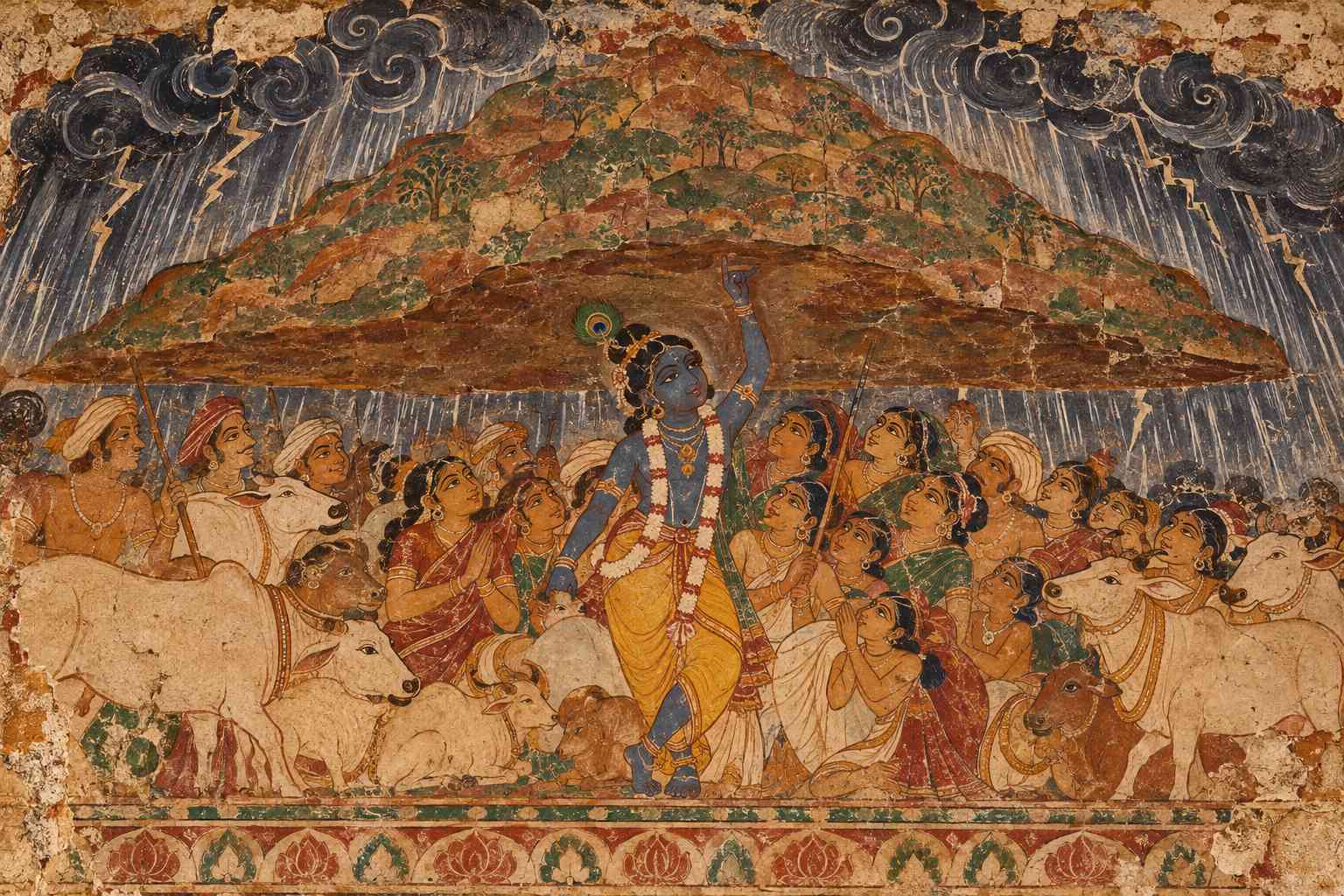
Govardhan Puja 2026 is on Tuesday, Nov 10. It celebrates the worship of Govardhan Hill that Kṛṣṇa Himself instructed (Krishna Book, Chapter 24).
Govardhan Puja is special because Kṛṣṇa Himself asked for it. He told the cowherd men of Vraja what to cook, whom to feed, how to decorate the cows and how to circle the hill. Devotees still follow those instructions today. Śrīla Prabhupāda explains that this festival is observed in the Kṛṣṇa consciousness movement and that “Lord Kṛṣṇa said that Govardhana Pūjā is as good as worship of Him” (Krishna Book, Chapter 24).
This article gives the 2026 date, the story of Govardhan Puja and the lifting of the hill from Śrīla Prabhupāda’s Krishna Book, the foods Kṛṣṇa named for the Annakut, and a simple way to perform Govardhan Puja at home.
When Is Govardhan Puja 2026?
Govardhan Puja falls on Pratipadā, the tithi that follows the Amavasya of Diwali. In 2026, it is on Tuesday, Nov 10.
- Govardhan Puja and Annakut: Tuesday, Nov 10
- Diwali: Sunday, Nov 8 / Monday, Nov 9
- Gopashtami: Tuesday, Nov 17
There is no separate “muhurat” to follow. The festival is the whole day: cooking for the Lord in the morning, the offering, the worship of the hill and the cows, and the distribution of prasādam. Follow the programme of your temple for the time of the main offering.
The Govardhan Puja Story: Why Krishna Asked Vraja to Worship Govardhan Hill
The story is told in Chapter 24 of Śrīla Prabhupāda’s Kṛṣṇa, the Supreme Personality of Godhead, “Worshiping Govardhana Hill.”
The Indra-yajna
One year, Kṛṣṇa noticed the cowherd men of Vṛndāvana preparing a great sacrifice. He asked His father, Nanda Mahārāja, what it was for. Nanda explained that it was for Indra, the King of heaven, who sends the clouds and the rain: “we must show some gratitude to the controller of this rainfall, Mahārāja Indra.”
Kṛṣṇa argued against it. Śrīla Prabhupāda explains that He had two reasons. First, as the Bhagavad-gītā states, all results derived from worshipping the demigods are temporary. Second, “whatever temporary result one derives from worshiping the demigods is actually granted by the permission of the Supreme Personality of Godhead.” Indra had become proud of his position, and Kṛṣṇa wanted to teach him a lesson.
Kṛṣṇa told His father that the people of Vṛndāvana had no need to look beyond their own home: “Our specific relationship is with Govardhana Hill and Vṛndāvana forest and nothing more.” He asked Nanda to use everything already gathered for Indra to worship Govardhan Hill and the local brāhmaṇas instead, and to do it immediately (Krishna Book, Chapter 24).
Krishna’s Own Instructions
Nanda Mahārāja agreed, and the cowherd men asked Kṛṣṇa how the sacrifice should be performed. These are His words, as given by Śrīla Prabhupāda:
“Prepare very nice foodstuffs of all descriptions from the grains and ghee collected for the yajña. Prepare rice, dahl, then halavah, pākorā, puri and all kinds of milk preparations like sweet rice, sweetballs, sandeśa, rasagullā and lāḍḍu and invite the learned brāhmaṇas who can chant the Vedic hymns and offer oblations to the fire. The brāhmaṇas should be given all kinds of grains in charity. Then decorate all the cows and feed them well. After performing this, give money in charity to the brāhmaṇas. As far as the lower animals are concerned, such as the dogs, and the lower grades of people, such as the cāṇḍālas, or the fifth class of men who are considered untouchable, they also may be given sumptuous prasādam. After giving nice grasses to the cows, the sacrifice known as Govardhana Pūjā may immediately begin. This sacrifice will very much satisfy Me.” (Krishna Book, Chapter 24)
Śrīla Prabhupāda adds that nobody is left out of this festival: “From this statement we learn also that the cats and dogs, although not so important, are not to be neglected.” (Krishna Book, Chapter 24)
Krishna Becomes the Hill
The cowherd men followed every instruction. Then something extraordinary happened. Kṛṣṇa “assumed a great transcendental form and declared to the inhabitants of Vṛndāvana that He was Himself Govardhana Hill,” and began to eat all the food offered. At the same time, in His usual form, Kṛṣṇa bowed down with the people of Vraja and said, “Just see how Govardhana Hill has assumed this huge form and is favoring us by accepting all the offerings.” (Krishna Book, Chapter 24)
This is why devotees worship Govardhan Hill as nondifferent from Kṛṣṇa. Śrīla Prabhupāda notes that devotees collect small stones from Govardhan Hill and worship them at home, “because this worship is as good as Deity worship” (Krishna Book, Chapter 24).
Why Did Krishna Lift Govardhan Hill?
The lifting of Govardhan Hill is told in Chapters 25 and 26 of the Krishna Book.
Indra’s Anger
When Indra learned that his sacrifice had been stopped, he became angry. He called for the sāṁvartaka, the cloud used to devastate the cosmic manifestation, and ordered it to flood Vṛndāvana. Indra dismissed Kṛṣṇa as “this talkative boy” and declared of the people of Vraja: “They should be destroyed with their cows.” (Krishna Book, Chapter 25)
The clouds poured down rain “as thick as pillars”, with constant lightning and thunder, heavy pieces of ice, strong winds and severe cold, until there was no visible distinction between higher and lower land. The cows, bowing their heads and sheltering their calves beneath their bodies, came to Kṛṣṇa for shelter, and the people of Vṛndāvana prayed to Him: “Now please protect us.” (Krishna Book, Chapter 25)
The Lifting of the Hill
Kṛṣṇa understood that this was Indra’s pride speaking. He resolved to take away Indra’s false prestige and to protect His devotees: “I shall give protection to My pure devotees in Vṛndāvana, who are at present completely at My mercy and whom I have taken completely under My protection.”
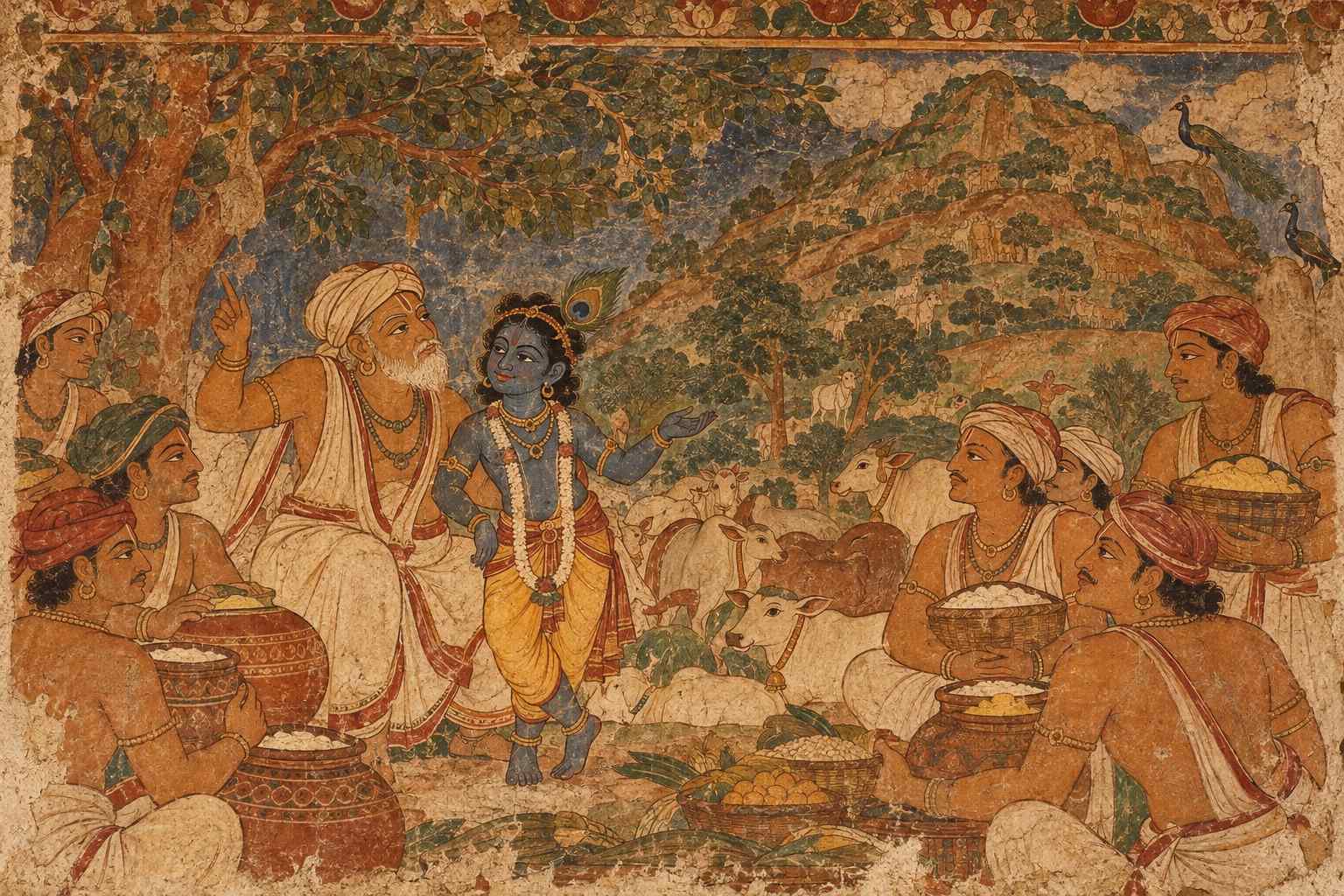
Then, Śrīla Prabhupāda writes, “Lord Kṛṣṇa immediately picked up Govardhana Hill with one hand, exactly as a child picks up a mushroom from the ground.” He called everyone beneath it: “Be happy along with your animals underneath this great umbrella.” (Krishna Book, Chapter 25)
The people and animals of Vṛndāvana stayed under the hill for one week, “without being disturbed by hunger, thirst or any other discomforts”, astonished to see Kṛṣṇa holding up the mountain “with the little finger of His left hand”. When Indra saw this, he called back his clouds. The sky cleared, and Kṛṣṇa set the hill back exactly where it had been (Krishna Book, Chapter 25).
“Wonderful Krishna”
Afterwards, the cowherd men could not stop talking about it. Kṛṣṇa was only seven years old. One of them said: “How was it possible for Him to lift Govardhana Hill in one hand and hold it up just like the king of elephants holds a lotus flower?” Nanda Mahārāja reminded them of the sage Garga’s words at Kṛṣṇa’s name-giving ceremony, that this boy “will be all-auspicious for my family” (Krishna Book, Chapter 26).
Indra’s Prayers: Mercy, Not Rivalry
Govardhan Puja is sometimes described as a contest between Kṛṣṇa and Indra. The Krishna Book shows something different. Indra came to Kṛṣṇa, fell at His lotus feet and admitted: “being puffed up by my false prestige, I thought that You had offended me.” He asked forgiveness: “As I am Your eternal servant, kindly excuse me.” (Krishna Book, Chapter 27)
Kṛṣṇa’s reply explains the whole pastime:
“My dear Indra, I have stopped your sacrifice just to show My causeless mercy and to revive your memory that I am your eternal master. I am not only your master, but I am the master of all the other demigods as well. You should always remember that all your material opulences are due to My mercy.” (Krishna Book, Chapter 27)
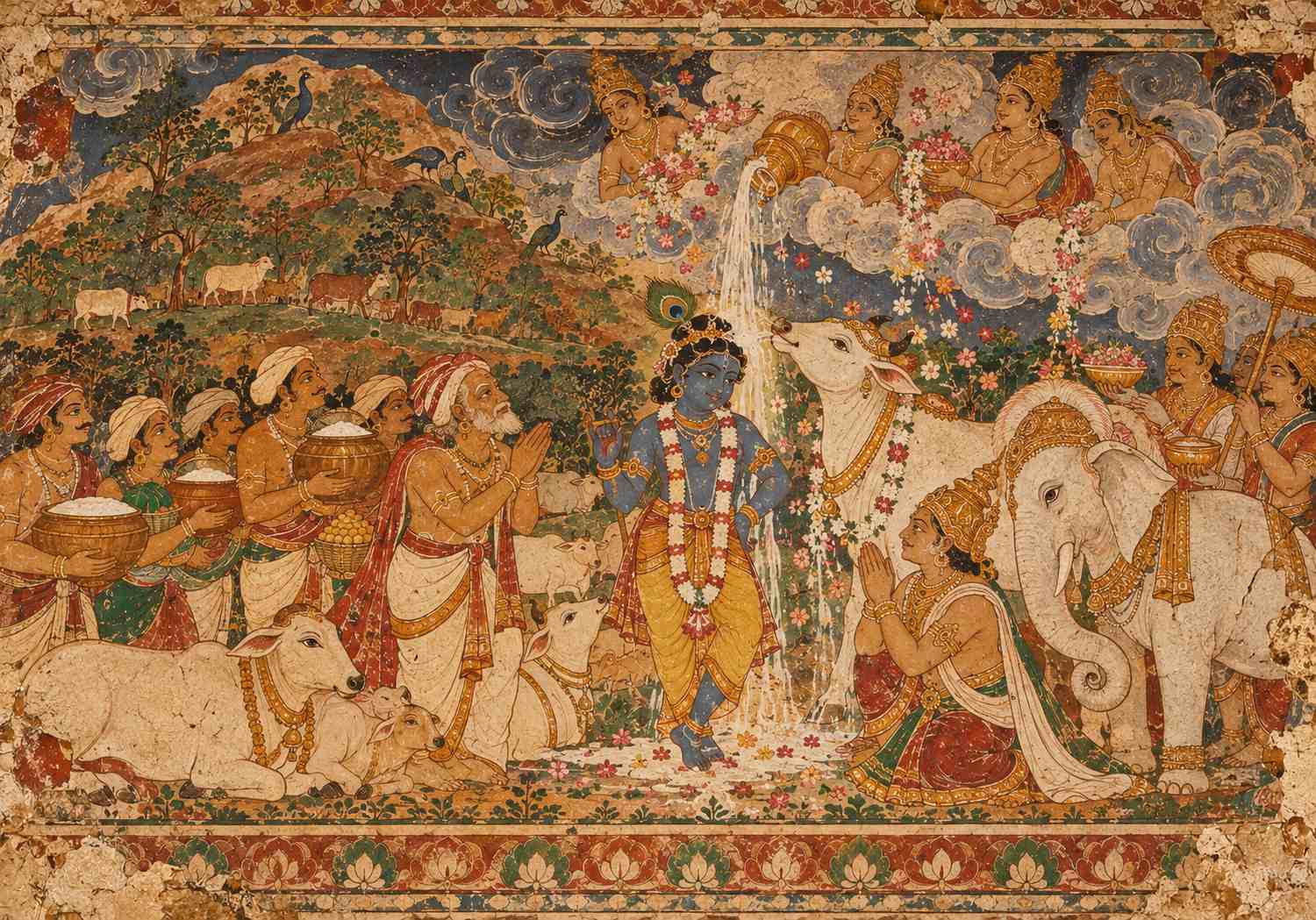
Kṛṣṇa sent Indra back to his kingdom, advising him “to remain as King of heaven, but to be careful of false pride.” The surabhi cow then bathed Kṛṣṇa with her milk, and Indra bathed Him with the water of the celestial Ganges. The surabhi prayed, “You are our Indra,” and Kṛṣṇa, the Lord of the cows, was glorified as Govinda (Krishna Book, Chapter 27).
What Is Annakut? The Offering Krishna Described
Annakut means “a mountain of food”. It is the name by which Govardhan Puja has been known ever since Kṛṣṇa’s first celebration. Śrīla Prabhupāda writes:
“The sacrifice known as Govardhana Pūjā is observed in the Kṛṣṇa consciousness movement. Lord Caitanya has recommended that since Kṛṣṇa is worshipable, so His land, Vṛndāvana and Govardhana Hill, are also worshipable. To confirm this statement, Lord Kṛṣṇa said that Govardhana Pūjā is as good as worship of Him. From that day, the Govardhana Pūjā has been still going on and is known as Annakūṭa.” (Krishna Book, Chapter 24)
The Foods Krishna Named
Kṛṣṇa’s own list, from His instructions to the cowherd men (Krishna Book, Chapter 24):
- Rice
- Dahl
- Halavah
- Pakora
- Puri
- Sweet rice
- Sweetballs
- Sandesh
- Rasagulla
- Laddu
The preparations were made “from the grains and ghee collected for the yajña”. Devotees today follow the same principle: cook as many grain and milk preparations as you can, with ghee, and offer them all to the Lord in one great offering.
Why the Food Is Shared So Widely
Annakut is a festival of distribution as much as offering. Śrīla Prabhupāda describes it: “In all the temples of Vṛndāvana or outside of Vṛndāvana, huge quantities of food are prepared in this ceremony and are very sumptuously distributed to the general population.” He adds that sometimes the food is thrown to the crowds, which shows “that prasādam offered to Kṛṣṇa never becomes polluted or contaminated, even if it is thrown on the ground” (Krishna Book, Chapter 24).
Chhappan Bhog
In many temples and homes, the Annakut offering is arranged as chhappan bhog, fifty-six preparations. A popular retelling connects the number with this pastime: Kṛṣṇa held up Govardhan Hill for seven days without eating, and afterwards the people of Vraja offered Him eight meals for each of those days, fifty-six preparations in all. This retelling is not found in Śrīla Prabhupāda’s Krishna Book; it comes from devotional tradition. At home, you can offer as many of the dishes Kṛṣṇa named as you can cook, with love.
Decorating the Cows and Circling Govardhan Hill
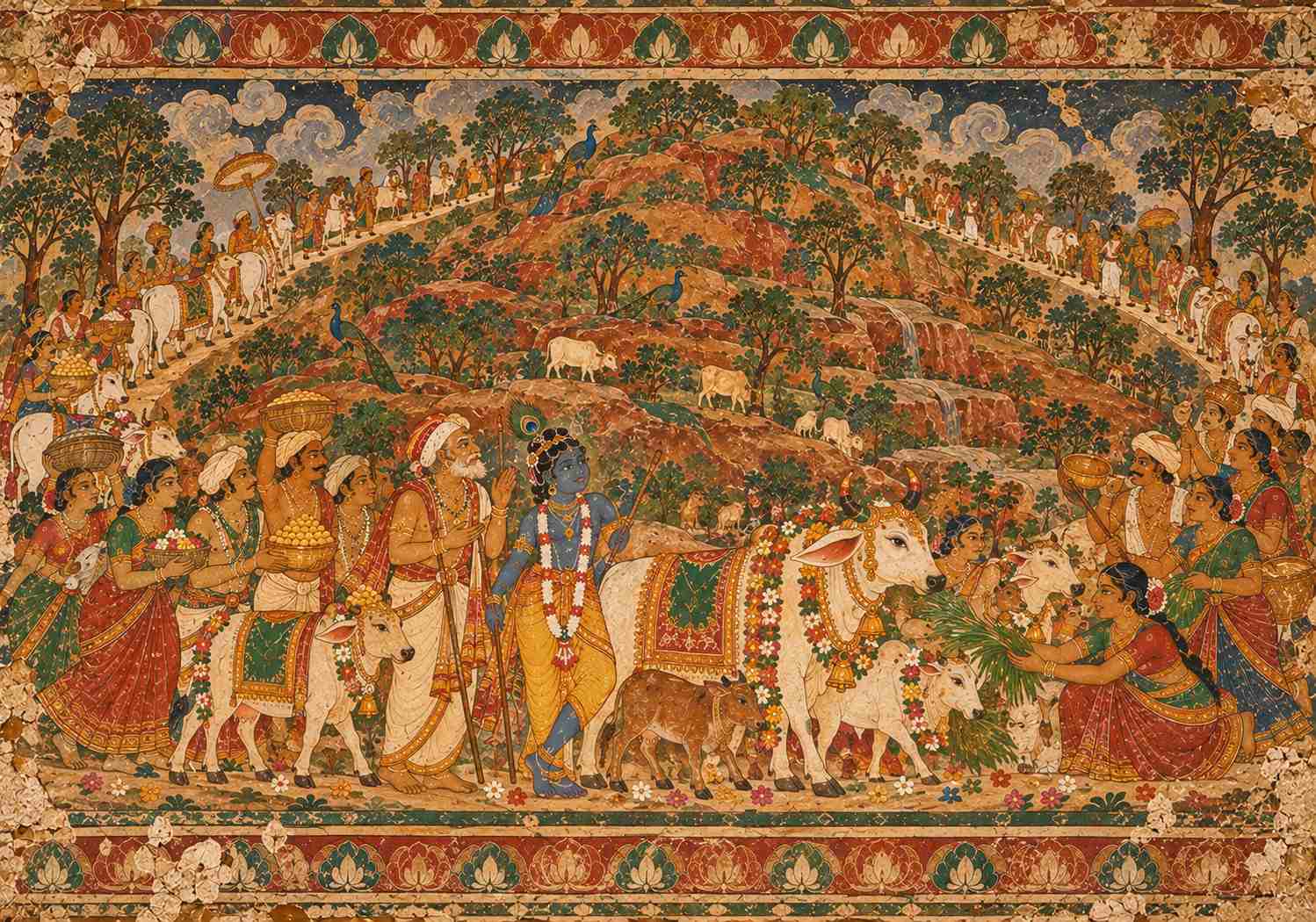
Cows are at the centre of Govardhan Puja. Kṛṣṇa’s instructions were clear: “Decorate all the cows and feed them well,” and give them nice grass before the worship begins. When the people of Vṛndāvana carried out the festival, Śrīla Prabhupāda writes that they “decorated their cows and gave them grass. Keeping the cows in front, they began to circumambulate Govardhana Hill” (Krishna Book, Chapter 24).
The custom continues in Vraja today. Śrīla Prabhupāda notes that people in Vṛndāvana “still dress nicely and assemble near Govardhana Hill to offer worship and circumambulate the hill, leading their cows all around” (Krishna Book, Chapter 24).
Cows are part of the whole pastime. Kṛṣṇa told His father that the proper duty of the vaiśya community, to which the cowherd men belonged, includes “protection of the cows” (Krishna Book, Chapter 24). When Indra’s rain fell, the cows came to Kṛṣṇa for shelter. And in the end, the surabhi cow herself bathed Kṛṣṇa with her milk and praised Him as the protector of the cows (Krishna Book, Chapter 27).
One week after Govardhan Puja comes Gopashtami, kept by tradition as the day Kṛṣṇa began to herd the cows. Read more in our guide, Gopashtami 2026: Date, Significance, Story and Gau Seva.
How to Do Govardhan Puja at Home
Before You Begin: Govardhan Puja at Home at a Glance
- When to do it: on Tuesday, Nov 10, after bathing, with the cooking done in the morning
- What you need: a picture of Śrī Kṛṣṇa lifting Govardhan Hill (or a Deity of Kṛṣṇa), Tulasī leaves, a ghee lamp, incense, flowers, and the Annakut preparations
- How difficult is it: simple; the main work is the cooking
- Who can do it: the whole family, including children
Step 1: Cook the Annakut
In a clean kitchen, prepare as many of the dishes Kṛṣṇa named as you can: rice, dahl, halavah, pakora, puri, sweet rice and milk sweets. Cook with ghee; keep out onion, garlic, meat, fish and eggs, and do not taste anything while cooking. The Lord is offered first.
Step 2: Build the Hill
Many families shape a small “hill” of food or of cooked rice before the Lord, with the other preparations arranged around it, as a reminder of Kṛṣṇa’s form as Govardhan accepting all the offerings. This is a devotional custom; a simple plate of each preparation is just as acceptable.
Step 3: Offer Obeisances to the Spiritual Master
Offer obeisances to the spiritual master and the disciplic succession. Then chant the Pañca-tattva mantra once: śrī-kṛṣṇa-caitanya prabhu-nityānanda śrī-advaita gadādhara śrīvāsādi-gaura-bhakta-vṛnda. Śrīla Prabhupāda writes, “At the beginning of every function in preaching, especially before chanting the Hare Kṛṣṇa mahā-mantra… we must chant the Pañca-tattva’s names and offer our respects to them” (Cc. Ādi 8.4, purport).
Step 4: Offer the Food with Tulasi
Place a Tulasī leaf on every preparation. In Vaiṣṇava practice, food is not offered to Śrī Kṛṣṇa without Tulasī. Offer incense, a ghee lamp and flowers, and ask the Lord to accept the Annakut. After a few minutes, the food is prasādam.
Step 5: Honour the Cows
If you live near cows, follow Kṛṣṇa’s instruction: give them fresh grass and something good to eat. If you do not, you can serve the cows through a gaushala.
Step 6: Circle the Hill
Many families walk around their Annakut “hill”, or the altar, while chanting the Hare Kṛṣṇa mahā-mantra, in memory of the circumambulation of Govardhan:
hare Kṛṣṇa, hare Kṛṣṇa, Kṛṣṇa Kṛṣṇa, hare hare
hare rāma, hare rāma, rāma rāma, hare hare.
(Bhagavad-gītā As It Is, Introduction)
Step 7: Distribute the Prasadam
Annakut is meant to be shared. Give prasādam to family, neighbours, guests and anyone in need, as Kṛṣṇa asked: even the dogs and the lowest classes of people were to receive “sumptuous prasādam” (Krishna Book, Chapter 24).
Common Mistakes to Avoid
- Worshipping the hill but forgetting the cows. Kṛṣṇa’s instructions include both.
- Offering without Tulasī. Place a Tulasī leaf on every preparation.
- Keeping the prasādam at home. Annakut is a festival of distribution; share it as widely as you can.
- Treating the day as a rivalry with Indra. The pastime ends in Indra’s prayers and Kṛṣṇa’s mercy, not in a defeat.
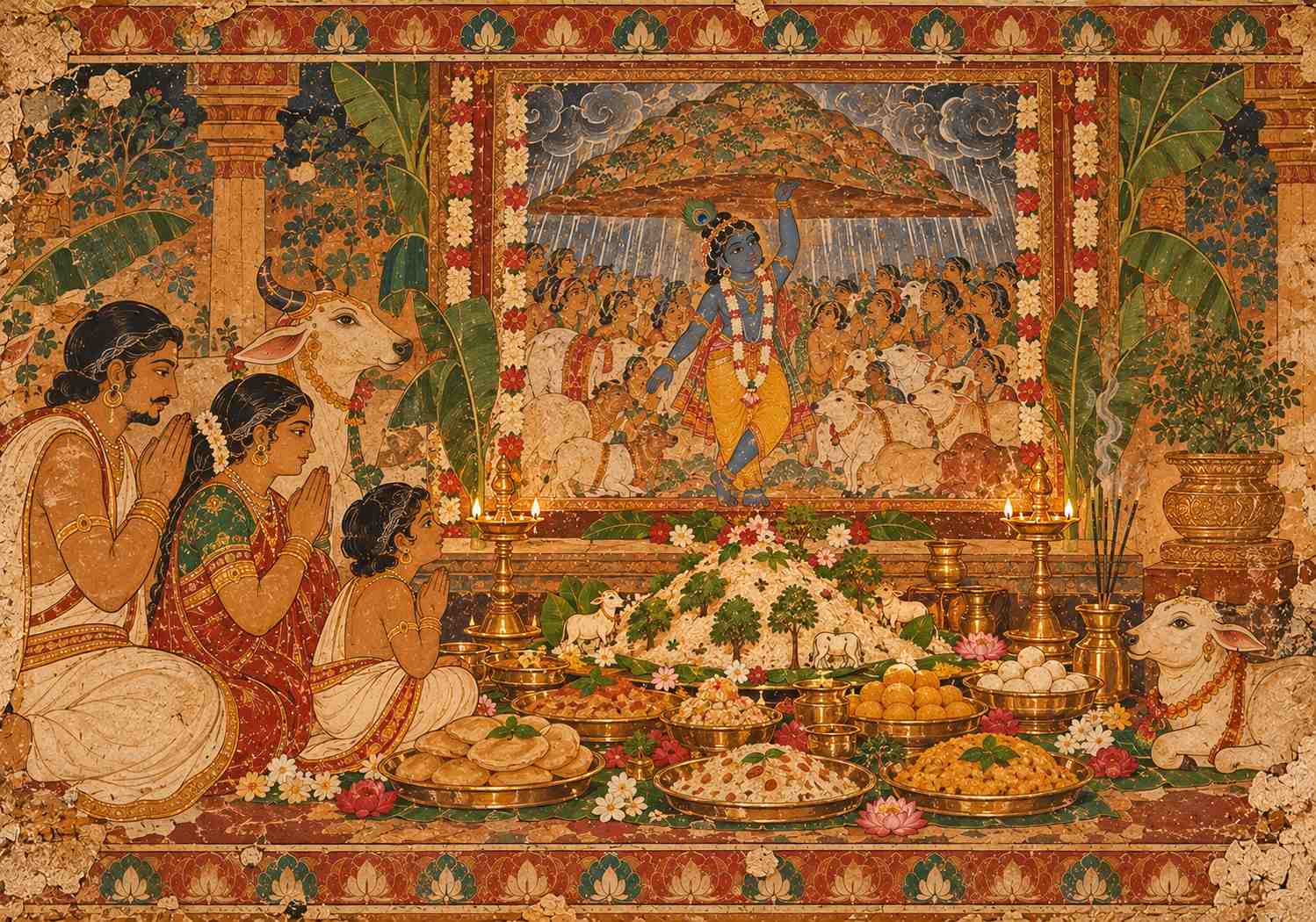
Govardhan Annakoot Seva and Annadan Seva at VCM
Vrindavan Chandrodaya Mandir celebrates Govardhan Puja and Annakut on Tuesday, Nov 10, during the temple’s Kartik vrata. Devotees who cannot be in Vraja this year may take part in the two services Kṛṣṇa Himself placed at the centre of the festival: the offering of food to the Lord and the feeding of the brāhmaṇas.
- Govardhan Annakoot Seva: Kṛṣṇa asked that many preparations be cooked and offered at Govardhan Puja. Govardhan Annakoot Seva is a contribution towards the temple’s Annakut offering to the Lord on Govardhan Puja day, with Annakut prasādam sent to your home. Offer Govardhan Annakoot Seva
- Annadan Seva: Kṛṣṇa asked that the brāhmaṇas be fed and given grains in charity. Annadan Seva supports the temple’s ongoing prasādam distribution to sādhus and pilgrims in Vṛndāvana. Offer Annadan Seva
Govardhan Puja falls in the middle of Kartik, the month of Lord Dāmodara. Read more in our guide, Kartik Maas 2026: Start Date, End Date and Significance.
Govardhan Puja 2026: FAQs
1. When is Govardhan Puja 2026?
Govardhan Puja falls on Tuesday, Nov 10, on Pratipadā, the tithi that follows the Amavasya of Diwali.
2. Is Govardhan Puja the same as Annakut?
Yes. Śrīla Prabhupāda writes that from the day Kṛṣṇa first performed it, “the Govardhana Pūjā has been still going on and is known as Annakūṭa” (Krishna Book, Chapter 24). Annakut refers to the great offering of food made on this day.
3. Is Govardhan Puja the day after Diwali?
It falls on the next tithi after Diwali. Diwali is kept on Amavasya, the new moon of Kartik, and Govardhan Puja on the following tithi, Pratipadā. In 2026, Pratipadā falls on Tuesday, Nov 10.
4. Did Krishna defeat Indra?
Kṛṣṇa humbled Indra’s pride, but the Krishna Book presents it as mercy, not rivalry. Kṛṣṇa told Indra, “I have stopped your sacrifice just to show My causeless mercy and to revive your memory that I am your eternal master” (Krishna Book, Chapter 27). Indra offered prayers, begged forgiveness, and was sent back to rule the heavens.
5. What foods are offered on Govardhan Puja?
Kṛṣṇa named them Himself: rice, dahl, halavah, pakora, puri, and milk preparations such as sweet rice, sweetballs, sandesh, rasagulla and laddu, all made from grains and ghee (Krishna Book, Chapter 24). Place a Tulasī leaf on each before offering.
6. How old was Krishna when He lifted Govardhan Hill?
Seven years old. The cowherd men of Vṛndāvana were amazed: “He is now only seven years old! How was it possible for Him to lift Govardhana Hill in one hand and hold it up just like the king of elephants holds a lotus flower?” (Krishna Book, Chapter 26)
7. How long did Krishna hold up Govardhan Hill?
One week. The people and animals of Vṛndāvana stayed beneath the hill “for one week without being disturbed by hunger, thirst or any other discomforts” (Krishna Book, Chapter 25).
8. Why are cows worshipped on Govardhan Puja?
Because Kṛṣṇa asked for it. His instructions were to “decorate all the cows and feed them well” and to give them nice grass before the worship of the hill began, and the people of Vṛndāvana circled Govardhan “keeping the cows in front” (Krishna Book, Chapter 24).
9. Can I do Govardhan Puja at home without a Govardhan shila?
Yes. A picture of Kṛṣṇa lifting Govardhan Hill, or a Deity of Kṛṣṇa, is enough. Cook the Annakut, offer it with Tulasī, honour the cows if you can, and share the prasādam widely.
10. What is chhappan bhog?
Fifty-six preparations offered to the Lord, a devotional tradition followed in many temples. A popular retelling links the number to Kṛṣṇa holding up Govardhan Hill for seven days; it is not found in Śrīla Prabhupāda’s Krishna Book. At home, you can offer as many of the dishes Kṛṣṇa named as you can cook, with a Tulasī leaf on each.
Hare Krishna!