
Hare Krishna!
Gopashtami 2026 is on Tuesday, Nov 17. According to tradition, it marks the day Kṛṣṇa and Balarāma began herding the cows.
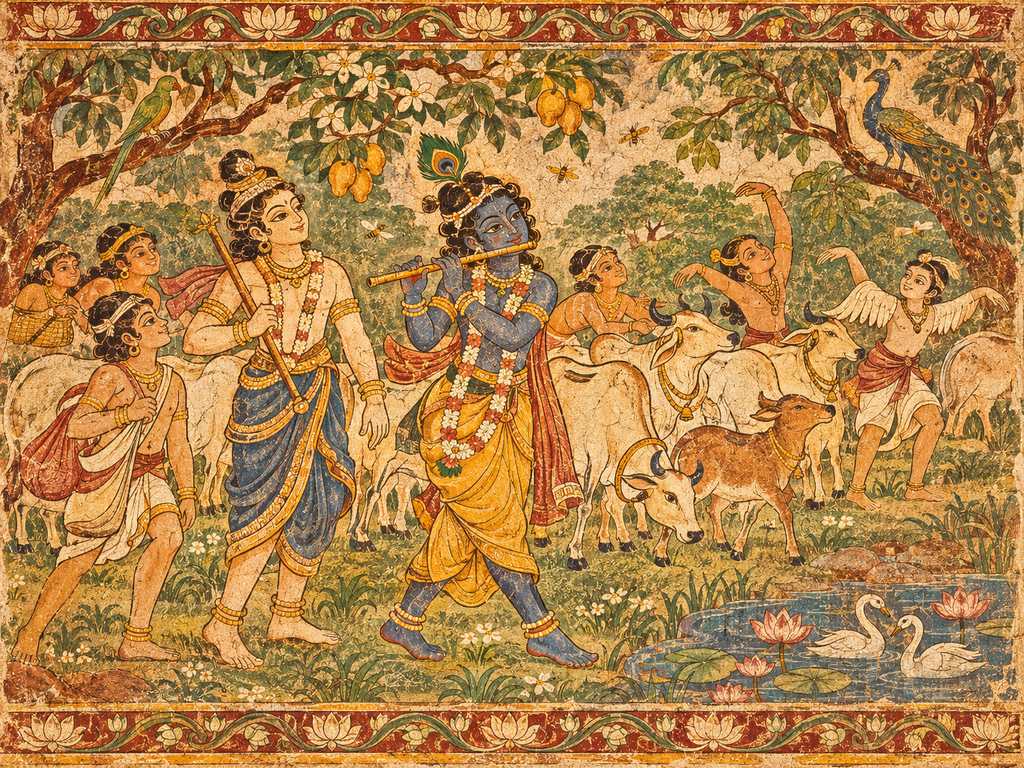
Kṛṣṇa, the Supreme Personality of Godhead, is known by many names, but few are as dear to the residents of Vraja as Gopāla, the protector of the cows, and Govinda, the one who gives pleasure to the cows. Gopashtami celebrates the day the child Kṛṣṇa, with His elder brother Balarāma, first took the cows of Vṛndāvana out to the pastures.
This article gives the 2026 date, the story from Śrīla Prabhupāda’s Krishna Book, what the Bhagavad-gītā says about cow protection, how Gopashtami is observed, and the difference between gau puja and gau seva.
When Is Gopashtami 2026?
Gopashtami falls on the eighth day (Ashtami) of the bright fortnight of Kartik. In 2026, it is on Tuesday, Nov 17, one week after Govardhan Puja.
- Govardhan Puja: Tuesday, Nov 10
- Gopashtami: Tuesday, Nov 17
- Kartik Purnima: Tuesday, Nov 24
The date of Gopashtami comes from tradition. Śrīla Prabhupāda’s Krishna Book describes Kṛṣṇa and Balarāma being given charge of the cows, but it does not name the day on which this happened.
What Is Gopashtami, and Why Is It Celebrated?
Go means “cow”, and aṣṭamī means “the eighth lunar day”. Gopashtami is the day devotees honour the cows and remember Kṛṣṇa as a cowherd boy.
Before this, Kṛṣṇa and Balarāma had been given charge of the calves (Krishna Book, Chapter 11). On Gopashtami, according to tradition, They were given charge of the grown cows and led them into the forests and pastures of Vṛndāvana for the first time.
For devotees, the festival is a reminder that the Supreme Personality of Godhead chose to spend His childhood among cows, calling each of them by name. Serving the cows on this day is a way of taking part in the life Kṛṣṇa Himself loved in Vraja.
The Gopashtami Story: Krishna and Balarama Begin Herding the Cows
The account is given at the opening of Chapter 15 of Śrīla Prabhupāda’s Krishna Book, “Killing of Dhenukāsura”.
The Paugaṇḍa Age
Śrīla Prabhupāda describes the moment Kṛṣṇa and Balarāma were given charge of the cows:
“In this way, Śrī Kṛṣṇa, along with His elder brother Balarāma, passed the childhood age known as kaumāra and stepped into the age of paugaṇḍa, from the sixth year up to the tenth. At that time, all the cowherd men conferred and agreed to give those boys who had passed their fifth year charge of the cows in the pasturing ground. Given charge of the cows, Kṛṣṇa and Balarāma traversed Vṛndāvana, purifying the land with Their footprints.” (Krishna Book, Chapter 15)
Into the Forest of Vrindavan
With Balarāma and the cowherd boys, Kṛṣṇa “brought forward the cows and played on His flute through the forest of Vṛndāvana, which was full of flowers, vegetables, and pasturing grass.” Śrīla Prabhupāda describes the forest as “as sanctified as the clear mind of a devotee”, full of bees, flowers, fruits, chirping birds and clear lakes (Krishna Book, Chapter 15).
The trees, heavy with fruit, bent down to touch the ground “as if welcoming Him by touching His lotus feet.” The boys imitated the humming of the drones, the calls of the swans and the dancing of the peacocks, and Kṛṣṇa moved His neck, imitating the dancing, to make His friends laugh (Krishna Book, Chapter 15).
Krishna Calls the Cows by Name
One line in this chapter captures the heart of Gopashtami:
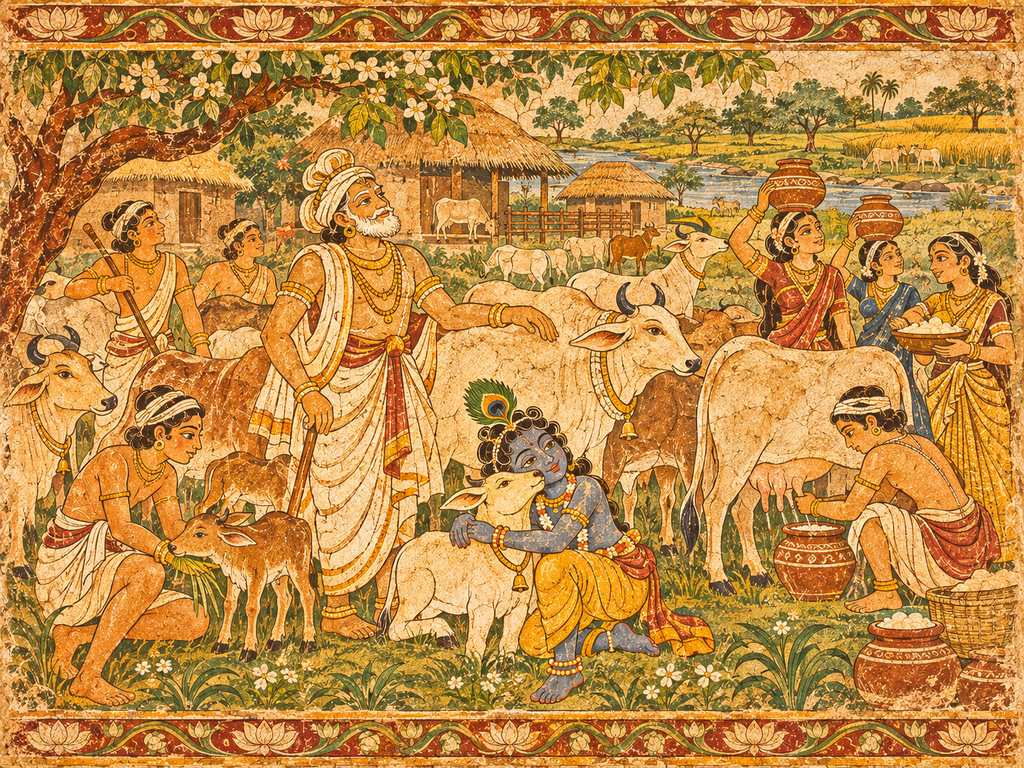
“The cows taken care of by Kṛṣṇa had different names, and Kṛṣṇa would call them with love. After hearing Kṛṣṇa calling, the cows would immediately respond by mooing, and the boys would enjoy this exchange to their hearts’ content.” (Krishna Book, Chapter 15)
The Lord of all creation knew every cow of Vṛndāvana by name, and they knew His voice.
The Supreme Lord as a Cowherd Boy
When Balarāma rested with His head on the lap of one of the boys, Kṛṣṇa would massage His legs and fan Him with a palm fan. When Kṛṣṇa lay down with a boy or a tree root as His pillow, the boys in turn would massage His legs and fan Him. Śrīla Prabhupāda explains what this means: “The Supreme Personality of Godhead, Kṛṣṇa, whose legs are tended by the goddess of fortune, shared Himself with the cowherd boys as one of them, expanding His internal potency to appear exactly like a village boy” (Krishna Book, Chapter 15).
At the end of the day, Kṛṣṇa and Balarāma returned to the village playing Their flutes, Their faces “smeared with the dust raised by the cows,” and Kṛṣṇa’s head decorated with a peacock feather (Krishna Book, Chapter 15).
Why Cow Protection Matters
In the Bhagavad-gita
In the Bhagavad-gītā, Kṛṣṇa describes the natural work of each section of society. For the vaiśyas, the farming and trading community, He names cow protection directly:
कृषिगोरक्ष्यवाणिज्यं वैश्यकर्म स्वभावजम् ।
परिचर्यात्मकं कर्म शूद्रस्यापि स्वभावजम् ॥४४॥
kṛṣi-go-rakṣya-vāṇijyaṁ
vaiśya-karma svabhāva-jam
paricaryātmakaṁ karma
śūdrasyāpi svabhāva-jam
The word-for-word meanings given by Śrīla Prabhupāda for the first line are: kṛṣi—ploughing; go—cows; rakṣya—protection; vāṇijyam—trade; vaiśya—vaiśya; karma—duty; svabhāva-jam—born of his own nature. His translation reads: “Farming, cattle raising and business are the qualities of work for the vaiśyas, and for the śūdras there is labor and service to others.” (Bg. 18.44)
Go-rakṣya, the protection of cows, is named alongside ploughing and trade as part of the duty of the vaiśya community.
In Krishna’s Own Family
Kṛṣṇa was raised in exactly such a community. In the Krishna Book, Śrīla Prabhupāda writes, “Kṛṣṇa identified Himself with the vaiśya community because Nanda Mahārāja was protecting many cows, and Kṛṣṇa was taking care of them” (Krishna Book, Chapter 24).
When Kṛṣṇa later instructed the people of Vraja to decorate and feed the cows at Govardhan Puja, He also asked that the dogs and the lowest classes of people be given prasādam. Śrīla Prabhupāda draws out the lesson:
“From this statement we learn also that the cats and dogs, although not so important, are not to be neglected. Cow protection is actually more important than protection of cats and dogs.” (Krishna Book, Chapter 24)
The cow is given special care because of her place in Kṛṣṇa’s own life and in the life of the community He came to protect. That is the spirit of Gopashtami.
How Is Gopashtami Observed? Gau Puja and Devotional Practices
Before You Begin: Gopashtami at a Glance
- When: Tuesday, Nov 17, in the morning
- What you need: a picture of Kṛṣṇa with the cows, Tulasī leaves, a ghee lamp, flowers, and food for the cows (fresh grass, fruit, jaggery or rotis)
- How difficult is it: simple
- Who can do it: anyone in the family, including children
Step 1: Offer Obeisances to the Spiritual Master
Bathe and set up the altar. Offer obeisances to the spiritual master and the disciplic succession. Then chant the Pañca-tattva mantra once: śrī-kṛṣṇa-caitanya prabhu-nityānanda śrī-advaita gadādhara śrīvāsādi-gaura-bhakta-vṛnda. Śrīla Prabhupāda writes, “At the beginning of every function in preaching, especially before chanting the Hare Kṛṣṇa mahā-mantra… we must chant the Pañca-tattva’s names and offer our respects to them” (Cc. Ādi 8.4, purport).
Step 2: Worship Krishna
Offer Kṛṣṇa a simple vegetarian preparation, cooked without onion or garlic, with a Tulasī leaf placed on it. In Vaiṣṇava practice, food is not offered to Kṛṣṇa without Tulasī. Offer a ghee lamp and flowers, then share the prasādam.
Step 3: Honour the Cows
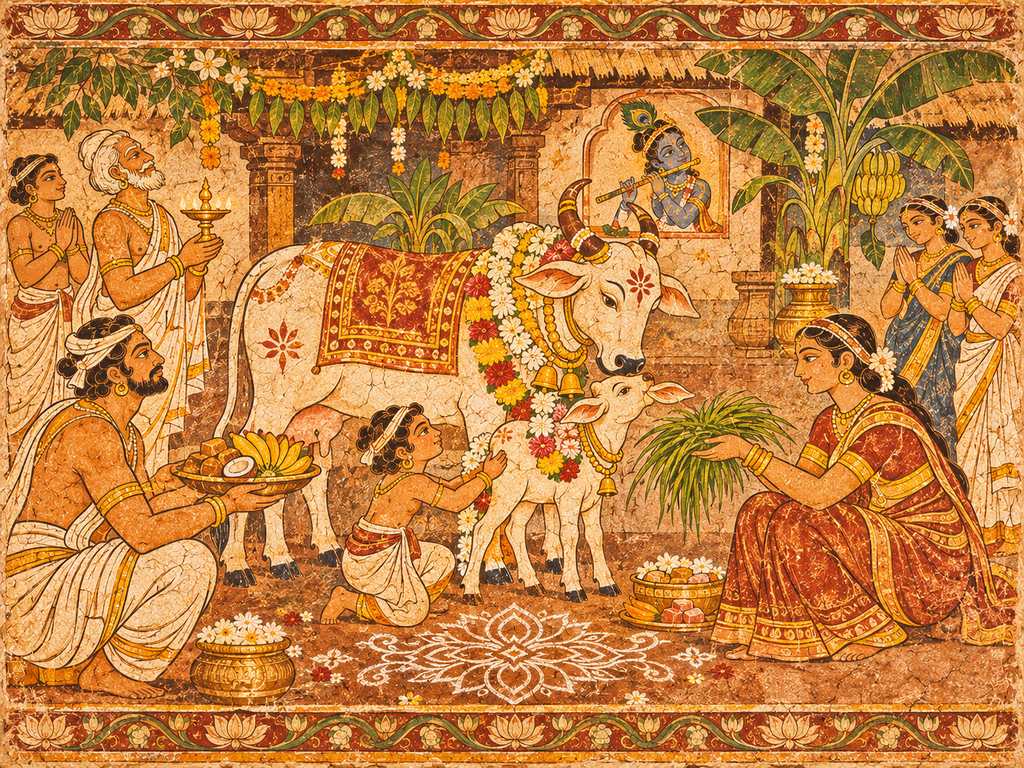
The traditional practices of Gopashtami are much like what Kṛṣṇa asked for at Govardhan Puja. In many places, families and gaushalas:
- Bathe and decorate the cows and calves with flowers and colours.
- Offer them fresh grass and good food.
- Walk around them respectfully.
If there is a gaushala near you, ask how you can help on the day.
Step 4: Hear the Pastime
Read aloud the opening of Chapter 15 of the Krishna Book, where Kṛṣṇa and Balarāma are given charge of the cows. It takes only a few minutes, and children enjoy hearing that Kṛṣṇa knew every cow by name.
Step 5: Chant
Chant the Hare Kṛṣṇa mahā-mantra as a family:
Hare Kṛṣṇa, Hare Kṛṣṇa, Kṛṣṇa Kṛṣṇa, Hare Hare
Hare Rāma, Hare Rāma, Rāma Rāma, Hare Hare.
(Bhagavad-gītā As It Is, Introduction)
Gau Puja and Gau Seva: What’s the Difference?
The two are often used as if they mean the same thing, but they are different.
- Gau puja is worship of the cow: bathing, decorating and feeding her, and walking around her on a festival day such as Gopashtami. It is an act of honour performed on a particular day.
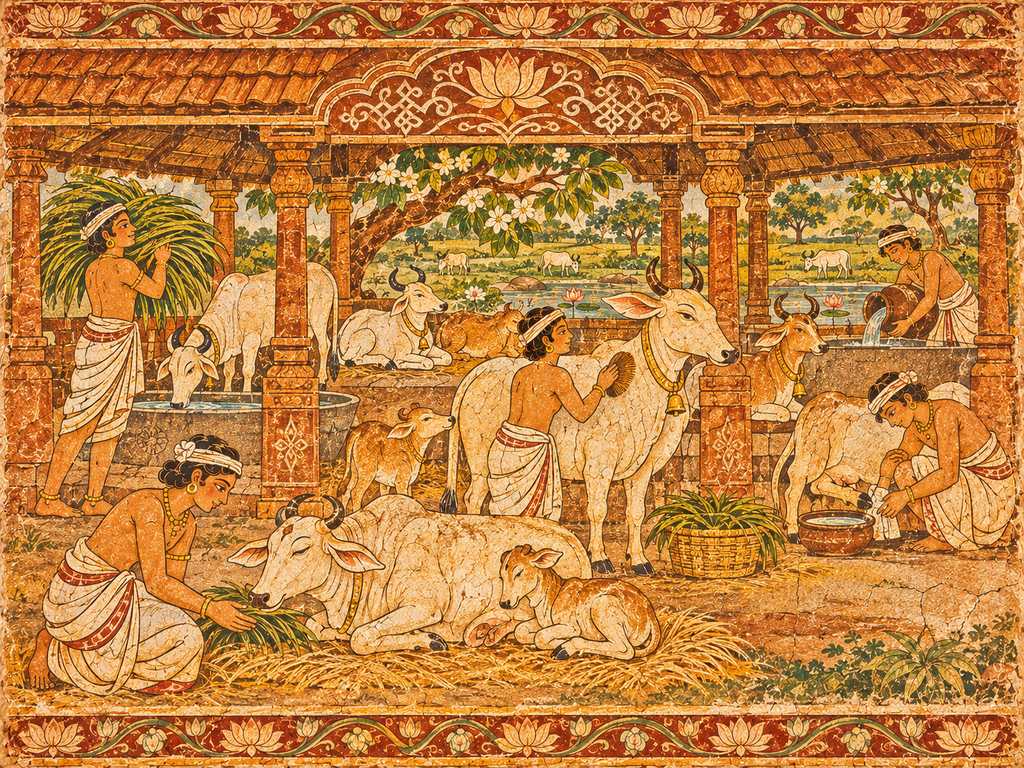
- Gau seva is service to the cow: feeding, sheltering and caring for her every day, including the old, sick and abandoned cows that can no longer give milk. It is ongoing.
Gopashtami is a day for gau puja. Gau seva is what continues after the festival is over, and it is the service Kṛṣṇa Himself performed every day in Vṛndāvana.
Gopashtami Gau Seva at VCM
Vrindavan Chandrodaya Mandir cares for the cows of its Surabhi Gaushala throughout the year. The cows are fed, sheltered and given medical care every day, not only on Gopashtami. Gau Seva helps feed the cows at our Surabhi Gaushala as part of that care.
Offering gau seva on Gopashtami is a way of joining the service Kṛṣṇa loved in the land where He herded the cows.
Gopashtami falls in Kartik, the month of Lord Dāmodara. Read more in our guide, Kartik Maas 2026: Start Date, End Date and Significance.
Gopashtami 2026: FAQs
1. When is Gopashtami 2026?
Gopashtami falls on Tuesday, Nov 17, the eighth day of the bright fortnight of Kartik.
2. Is Gopashtami the day Krishna began herding the cows?
According to tradition, yes. The Krishna Book describes Kṛṣṇa and Balarāma entering the paugaṇḍa age, “from the sixth year up to the tenth,” when the cowherd men agreed to give the boys “charge of the cows in the pasturing ground” (Krishna Book, Chapter 15). Kṛṣṇa grew up in Vraja, in the home of Nanda Mahārāja and the cowherd community; this was the day He began to herd the cows. The Krishna Book does not give the date; its link to Gopashtami comes from tradition.
3. Is Gopashtami related to Govardhan Puja?
Both festivals honour the cows of Vraja, and both fall in Kartik. At Govardhan Puja, Kṛṣṇa asked the people of Vraja to “decorate all the cows and feed them well” (Krishna Book, Chapter 24). Gopashtami comes one week later. Read more in our guide, Govardhan Puja 2026: Date, Story, Annakut and Significance.
4. What is the difference between gau puja and gau seva?
Gau puja is the worship of the cow on a festival day: bathing, decorating, feeding and circling her. Gau seva is everyday care: food, shelter and medical attention, including for cows that no longer give milk.
5. Can I offer gau seva from home?
Yes. If you cannot care for cows yourself, you can support a gaushala that does. Vrindavan Chandrodaya Mandir’s Gau Seva supports the ongoing care of the cows at its Surabhi Gaushala.
6. What do the names Gopala and Govinda mean?
Both names connect Kṛṣṇa with the cows. Gopāla is the protector of the cows. Govinda is the name glorified when the surabhi cow bathed Kṛṣṇa with her milk after He lifted Govardhan Hill, and Śrīla Prabhupāda describes Him there as “the Lord of all the cows in Vṛndāvana, who is known as Govinda” (Krishna Book, Chapter 27).
7. What should I feed the cows on Gopashtami?
Fresh green grass is the simplest and best. Many families also offer fruit, jaggery or rotis. Ask the gaushala what is suitable for their cows.
8. Can children take part?
Yes. Gopashtami is one of the easiest festivals for children: they can help decorate and feed the cows and hear the story of Kṛṣṇa calling each cow by name.
Hare Krishna!