
Hare Krishna!
Diwali is celebrated, according to tradition, for Lord Rāma’s return to Ayodhyā and, in Gauḍīya Vaiṣṇava tradition, for Śrī Kṛṣṇa’s Dāmodara-līlā. Lord Rāma is not different from Kṛṣṇa: Śrīla Prabhupāda describes Him as “Lord Rāmacandra, of the Rāmāyaṇa, an incarnation of Kṛṣṇa” (Bg. 10.31, purport). So both pastimes are about the same Supreme Lord.
Diwali 2026 falls on Sunday, Nov 8 or Monday, Nov 9, depending on how your calendar counts the day.
This article explains what Diwali means, what the Śrīmad-Bhāgavatam says about Lord Rāma’s return, how the festival connects to Kṛṣṇa, why lamps are offered, and how to celebrate Diwali at home as a devotional festival, step by step.
Diwali 2026: Key Facts
-
Date: Sunday, Nov 8 / Monday, Nov 9
-
Tithi: Kartik Amavasya, the new moon of the month of Kartik
-
Amavasya begins: Sunday, Nov 8, at 11:29 AM
-
Amavasya ends: Monday, Nov 9, at 12:32 PM
-
Dhanteras: Friday, Nov 6 / Saturday, Nov 7
-
Govardhan Puja: Tuesday, Nov 10
What Does Diwali (Deepavali) Mean?
Diwali is the popular form of Deepavali, from dīpa, a lamp, and āvali, a row. Deepavali means a row of lamps.
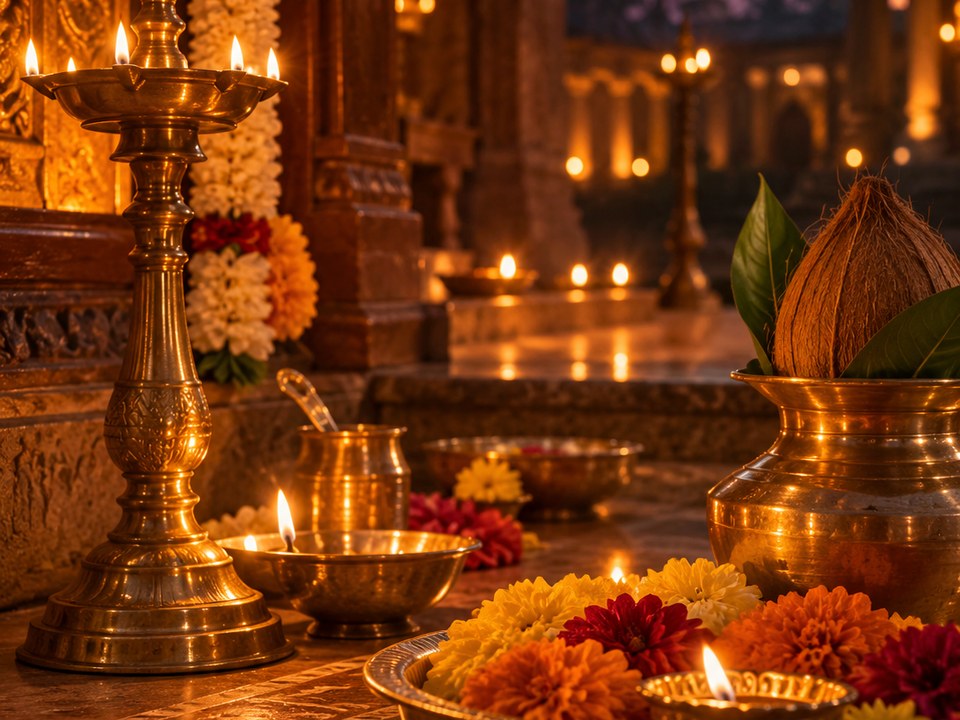
The festival falls on the new moon of Kartik, the darkest night of the month, and in the middle of the month devotees dedicate to Lord Dāmodara. Throughout Kartik, devotees offer a lamp to the Lord every evening. On Diwali, they light many lamps.
Lord Rama’s Return to Ayodhya
The Śrīmad-Bhāgavatam tells Lord Rāma’s pastimes in the Ninth Canto, Chapter 10. Śukadeva Gosvāmī says he will describe them only in brief, because King Parīkṣit has heard them many times already (SB 9.10.3). The account of the Lord’s return to Ayodhyā is also short.
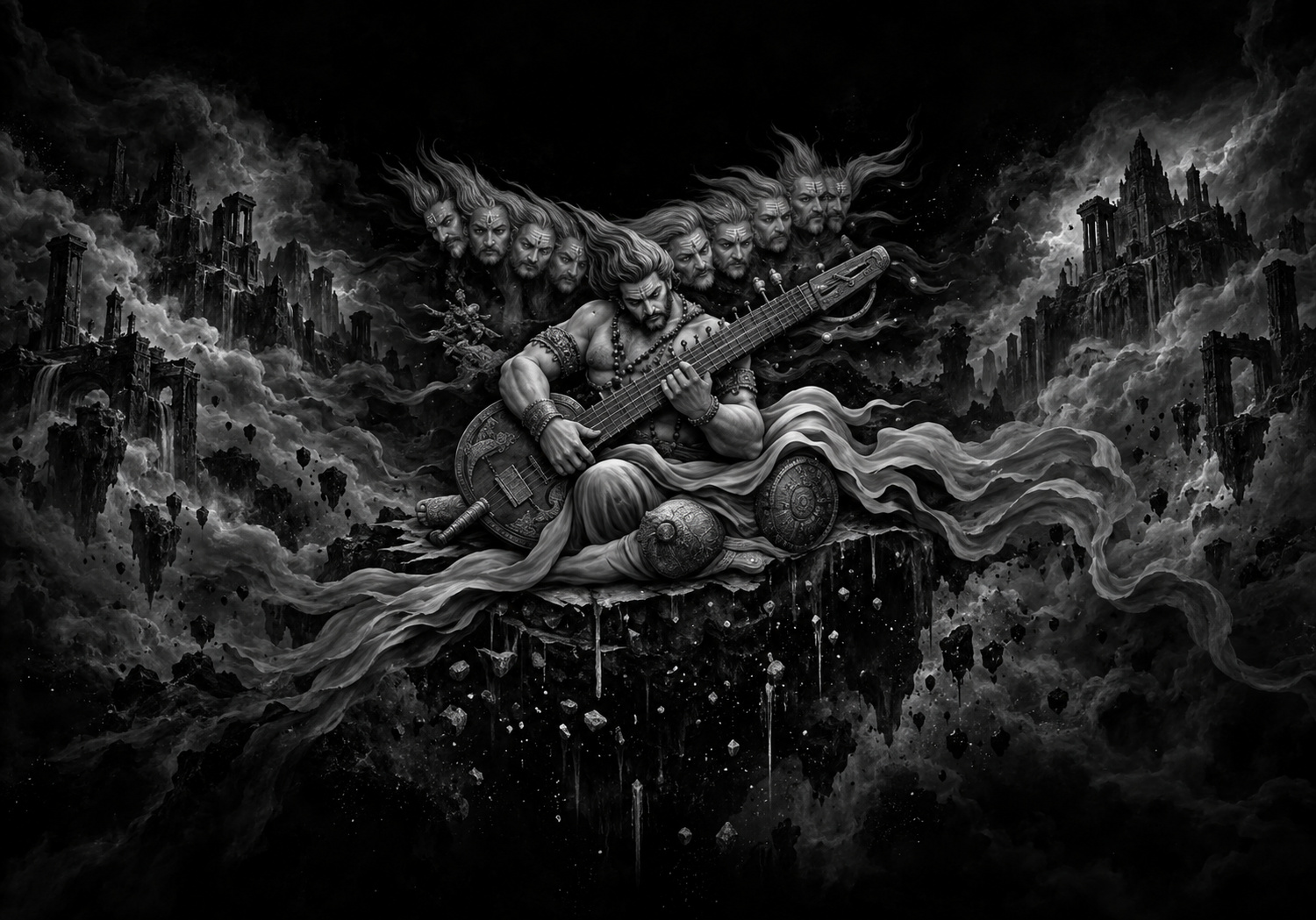
Who Is Lord Rama?
The Bhāgavatam opens the chapter by stating who He is. Being prayed for by the demigods, the Supreme Personality of Godhead appeared with His expansions as Rāma, Lakṣmaṇa, Bharata and Śatrughna, the four sons of Mahārāja Daśaratha (SB 9.10.2). In the Bhagavad-gītā, Kṛṣṇa names Rāma among His own opulences:
पवनः पवतामस्मि रामः शस्त्रभृतामहम् ।
झषाणां मकरश्चास्मि स्रोतसामस्मि जाह्नवी ॥३१॥
pavanaḥ pavatām asmi
rāmaḥ śastra-bhṛtām aham
jhaṣāṇāṁ makaraś cāsmi
srotasām asmi jāhnavī
“Of purifiers I am the wind; of the wielders of weapons I am Rāma; of fishes I am the shark, and of flowing rivers I am the Ganges.” (Bg. 10.31)
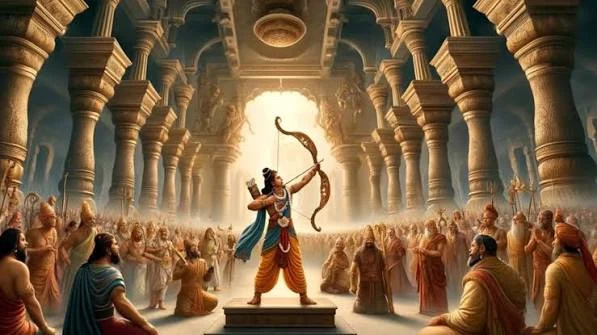
In the purport, Śrīla Prabhupāda identifies this Rāma as “Lord Rāmacandra, of the Rāmāyaṇa, an incarnation of Kṛṣṇa.”
Bharata’s Austerities
To keep His father’s promise, Lord Rāma gave up the throne and went to the forest with Sītā and Lakṣmaṇa (SB 9.10.4, 9.10.8). When Rāma returned, He learned that throughout His absence Bharata had been living outside the city in austerity, eating barley, wearing the bark of trees, keeping matted hair and sleeping on kuśa grass. The Bhāgavatam says the most merciful Lord “very much lamented this” (SB 9.10.34).
The Welcome
After the battle at Laṅkā, the Lord placed Sītā on an airplane decorated with flowers and returned to Ayodhyā with Hanumān, Sugrīva and Lakṣmaṇa (SB 9.10.32). On the road, the princely order showered Him with fragrant flowers, and Lord Brahmā and the demigods glorified Him (SB 9.10.33).
When Bharata heard that Rāma was coming, he placed the Lord’s wooden shoes on his own head and came out from his camp at Nandigrāma. With him came ministers, priests and citizens; musicians; brāhmaṇas chanting Vedic hymns; and chariots decorated with flags embroidered in gold. Bharata, “His heart softened in ecstasy and His eyes full of tears,” fell at the Lord’s lotus feet (SB 9.10.35–38). Lord Rāma embraced him with both arms for a long time, bathing him with tears (SB 9.10.39–40).
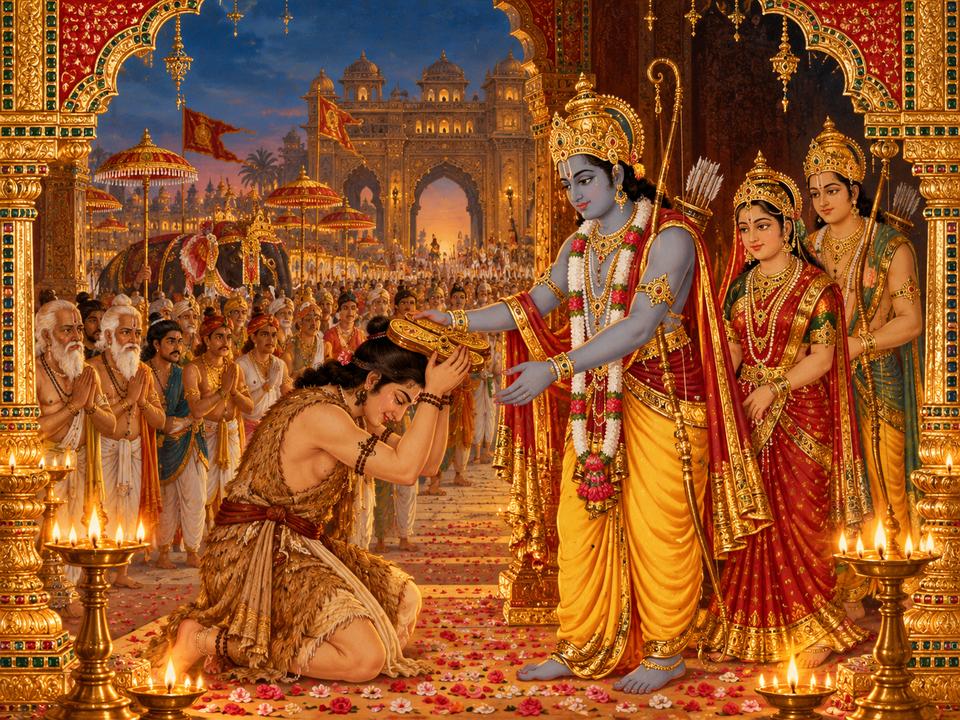
Then the people of Ayodhyā welcomed their King:
dhunvanta uttarāsaṅgān
patiṁ vīkṣya cirāgatam
uttarāḥ kosalā mālyaiḥ
kiranto nanṛtur mudā
“The citizens of Ayodhyā, upon seeing their King return after a long absence, offered Him flower garlands, waved their upper cloths, and danced in great jubilation.” (SB 9.10.41)
The Lord entered the city “in the midst of a festival” (SB 9.10.45–46), and the sage Vasiṣṭha performed His abhiṣeka with the water of the four seas (SB 9.10.48). Lord Rāma accepted the throne and cared for the citizens like a father (SB 9.10.50).
How Rama’s Welcome Became a Festival of Lamps
The Bhāgavatam’s account describes flowers, flags, garlands, music and dancing. The lamps of Diwali come from tradition, which has long celebrated the Lord’s return by lighting rows of lamps on the new moon of Kartik.
Diwali and Krishna: The Damodar Lila
In the Gauḍīya Vaiṣṇava tradition, Diwali is also the day of Kṛṣṇa’s Dāmodara-līlā, the pastime told in the Śrīmad-Bhāgavatam, Canto 10, Chapter 9.
In brief: Mother Yaśodā left the child Kṛṣṇa to attend to milk boiling over on the stove. In anger, He broke the pot of yoghurt and fed the butter to the monkeys. When she caught Him, she decided to bind Him to a wooden mortar, but every rope she brought was short by the width of two fingers (SB 10.9.15–17). Only when Kṛṣṇa saw His mother perspiring and tired did He become “merciful to her and agreed to be bound” (SB 10.9.18).
The Bhāgavatam draws the lesson in the next verse: the whole universe is under the control of the Supreme Lord, yet “He comes under the control of His devotees” (SB 10.9.19). The name Dāmodara comes from this pastime: “Dāmodara refers to Kṛṣṇa’s being bound with rope by His mother, Yaśodā” (The Nectar of Devotion, Chapter 12). The whole month of Kartik is dedicated to Him.
The Bhāgavatam does not give a date for the pastime; its link to Diwali comes from Gauḍīya Vaiṣṇava tradition. The full pastime, including the deliverance of the Yamala-arjuna trees (SB 10.10), is told in our guide, Kartik Maas 2026: Start Date, End Date and Significance.
Why Are Lamps Offered on Diwali?
Lighting lamps on Diwali is an old tradition, and the lamps have a meaning in both pastimes:
-
For Lord Rāma, the lamps are a welcome. By tradition, Ayodhyā was lit up to receive its King after His long absence.
-
For Lord Dāmodara, the lamps are an offering. Throughout Kartik, devotees offer a ghee lamp to the Lord every evening while singing the Dāmodarāṣṭakam. On Diwali, devotees offer this lamp first, and then light lamps all around the house.
For a devotee, the first lamp of the evening is offered to the Lord. The remaining lamps light the house in His honour. The method of offering a lamp in Kartik is given step by step in the deep daan section of our Kartik Maas 2026 guide.
Diwali 2026 Date and Tithi
|
Tithi |
Begins |
Ends |
Day counted by sunrise tithi |
|---|---|---|---|
|
Kartik Amavasya |
Sunday, Nov 8, 11:29 AM |
Monday, Nov 9, 12:32 PM |
Monday, Nov 9 |
Times are in IST.
Why Calendars Show Two Dates
A tithi does not begin and end at midnight, so it often falls across two calendar days. In 2026, Amavasya begins at 11:29 AM on Nov 8 and ends at 12:32 PM on Nov 9.
Many calendars choose the day on which Amavasya is present in the evening, which is Nov 8. The Gauḍīya Vaiṣṇava calendar observes the day by the tithi present at sunrise, which is Nov 9. Both are honest attempts to follow the same tithi. Follow the custom of your family and local temple.
How to Celebrate Diwali as a Devotional Festival
Before You Begin: Diwali at Home at a Glance
-
When to do it: in the evening of Diwali, after bathing, with the cooking done beforehand
-
What you need: a picture or Deity of Śrī Kṛṣṇa (or of Sītā-Rāma, Lakṣmaṇa and Hanumān), Tulasī leaves, a ghee lamp, incense, flowers, and food cooked for the Lord
-
How difficult is it: simple, with no Sanskrit or special training needed
-
Who can do it: anyone in the family, including children
Step 1: Prepare the Home
Clean the house in the days before Diwali. On the day, bathe and put on clean clothes. Set up the altar with a fresh cloth, the Lord’s picture or Deity, and a Tulasī plant or fresh Tulasī leaves beside Him.
Step 2: Cook for the Lord
Prepare the festival food in a clean kitchen, with no onion, garlic, meat, fish or eggs, and do not taste it while cooking. Place a Tulasī leaf on each preparation. In Vaiṣṇava practice, food is not offered to Śrī Kṛṣṇa without Tulasī.
Step 3: Offer Obeisances to the Spiritual Master
Offer obeisances to the spiritual master and the disciplic succession. Then chant the Pañca-tattva mantra once: śrī-kṛṣṇa-caitanya prabhu-nityānanda śrī-advaita gadādhara śrīvāsādi-gaura-bhakta-vṛnda. Śrīla Prabhupāda writes, “At the beginning of every function in preaching, especially before chanting the Hare Kṛṣṇa mahā-mantra… we must chant the Pañca-tattva’s names and offer our respects to them” (Cc. Ādi 8.4, purport).
Step 4: Offer the Food
Place the plate before the Lord. Offer incense and flowers, and ask Him, in your own words or by chanting His holy name, to accept what you have cooked. After a few minutes, the food is prasādam. Share it with the family, and give the prasādam sweets to neighbours and guests.
Step 5: Offer the First Lamp
Before lighting any lamp in the house, light a ghee lamp and offer it to the Lord, moving it in slow circles before Him. Then offer it to Tulasī. Many devotees sing the Dāmodarāṣṭakam while offering the lamp, as they do every evening of Kartik.
Step 6: Light the Home
Now light the rows of lamps at the doorway, windows and balcony. Ghee lamps are traditional; oil lamps are also used.
Step 7: Hear and Chant Together
Read aloud the account of Lord Rāma’s return from SB 9.10.32–50, or the Dāmodara-līlā from SB 10.9. Then chant the Hare Kṛṣṇa mahā-mantra together as a family:
hare Kṛṣṇa, hare Kṛṣṇa, Kṛṣṇa Kṛṣṇa, hare hare
hare rāma, hare rāma, rāma rāma, hare hare.
(Bhagavad-gītā As It Is, Introduction)
The mantra is made entirely of the Lord’s names, and it needs no initiation or knowledge of Sanskrit. Chant it aloud as a kīrtana with the whole family.
Common Mistakes to Avoid
-
Lighting the house before offering the Lord a lamp. The first lamp is His.
-
Offering food without Tulasī. Place a Tulasī leaf on each preparation.
-
Tasting the festival food before it is offered. The Lord is offered first; the family eats after.
-
Skipping the kīrtana. However else the evening is celebrated, make time to chant together as a family.
Regional Customs: Lakshmi–Ganesha Puja
In many parts of India, the principal ritual of Diwali night is Lakṣmī–Gaṇeśa pūjā, performed in the evening while Amavasya is present. Business families traditionally open new account books on this day. In Bengal and Odisha, the same new-moon night is observed as Kālī pūjā.
These are regional customs; they are not taught by Śrīla Prabhupāda. At VCM, we do not observe these customs, as they are not part of our paramparā; our worship is offered to Kṛṣṇa alone. Families who keep them follow their local custom.
Celebrate Diwali with Deepdaan Seva at VCM
Vrindavan Chandrodaya Mandir celebrates Diwali on Monday, Nov 9, during the temple’s Kartik vrata. In The Nectar of Devotion, Śrīla Prabhupāda writes that devotional service in the month of Kartik “is especially recommended to be performed at Mathurā”, and that many devotees still go to Mathurā or Vṛndāvana to serve the Lord there during this month (The Nectar of Devotion, Chapter 12).
Devotees who cannot travel to Vṛndāvana this Diwali may offer a lamp to the Lord through the temple:
-
Deepdaan Seva: a lamp offered to the Lord in Vṛndāvana this Kartik. Offer Deepdaan Seva
-
Pushpa Shringar & Sankalpa Seva: offer fresh flowers to adorn Sri Radha Vrindavan Chandra this Diwali, with a sankalpa performed in your name. Offer Pushpa Shringar & Sankalpa Seva
Diwali 2026: FAQs
1. Is Diwali 2026 on Nov 8 or Nov 9?
Amavasya runs from 11:29 AM on Sunday, Nov 8 to 12:32 PM on Monday, Nov 9. Many calendars list Diwali on Nov 8, because Amavasya is present that evening. Counted by the tithi at sunrise, the day is Nov 9. Follow the custom of your family and local temple. You can see how we celebrate it at VCM above.
2. What is the connection between Diwali and Krishna?
In Gauḍīya Vaiṣṇava tradition, Diwali is the day of Kṛṣṇa’s Dāmodara-līlā, when Mother Yaśodā bound Him with ropes (SB 10.9). The festival also falls in the middle of Kartik, the month dedicated to Lord Dāmodara. And Lord Rāma, whose return Diwali celebrates, is an incarnation of Kṛṣṇa (Bg. 10.31, purport).
3. Do the scriptures describe Ayodhya lit with lamps when Lord Rama returned?
The Śrīmad-Bhāgavatam’s account (SB 9.10) describes flowers, flags, garlands, music and dancing. The lamps of Diwali come from tradition.
4. Who is worshipped on Diwali?
Lord Rāma, with Sītā, Lakṣmaṇa and Hanumān, and Śrī Kṛṣṇa, whose Dāmodara-līlā is remembered on this day. In many regions, families also perform Lakṣmī–Gaṇeśa pūjā as a regional custom.
5. Why is Diwali celebrated on Amavasya?
Diwali falls on the new moon of Kartik, the darkest night of the month. By tradition, the lamps lit on this night welcome Lord Rāma home. Devotees also offer a lamp to Lord Dāmodara, as on every evening of Kartik.
6. Can I celebrate Diwali at home without a Deity?
Yes. A clean, respectfully kept picture of Śrī Kṛṣṇa, or of Sītā-Rāma, Lakṣmaṇa and Hanumān, is enough. Keep Tulasī beside the Lord, offer the food and the first lamp before Him, and chant His holy name with the family.
7. What should I offer the Lord on Diwali?
Any vegetarian preparation cooked with care, without onion or garlic, with a Tulasī leaf placed on it. Families usually cook festival sweets; offer them to Kṛṣṇa first, then distribute them as prasādam.
8. Should I use ghee or oil lamps?
For the lamp offered to the Lord, ghee is traditional. Oil lamps are commonly used to light the rest of the house.
9. Can children take part?
Yes, and Diwali is one of the easiest festivals for them to join. Children can help clean and decorate the altar, arrange flowers, light the house lamps after the first lamp is offered, and lead the family kīrtana.
10. Is Govardhan Puja the day after Diwali?
Govardhan Puja and Annakut fall on Tuesday, Nov 10. Where Diwali is kept on Nov 9, it is the next day. See our guide, Govardhan Puja 2026: Date, Story, Annakut and Significance.