
Introduction
Hare Kṛṣṇa!
We celebrate Dussehra to remember Lord Rāmacandra's victory over Rāvaṇa and the rescue of Sītā. Lord Rāma is an incarnation of Kṛṣṇa, and His victory shows how the Lord protects His devotees and restores dharma.
The day has been kept by devotees for centuries. Five hundred years ago, Śrī Caitanya Mahāprabhu celebrated it at Jagannātha Purī by dressing His devotees as Lord Rāma's monkey army (Śrī Caitanya-caritāmṛta, Madhya 15.32).
This article tells the story of Dussehra as Śrīmad-Bhāgavatam gives it, explains what the names Dussehra and Vijayadashami mean, looks at what the day teaches, and describes how it is celebrated today.
For the Dashami tithi timings and a home puja vidhi, see our guide, Dussehra 2026: Date, Tithi, Puja Vidhi and Significance.
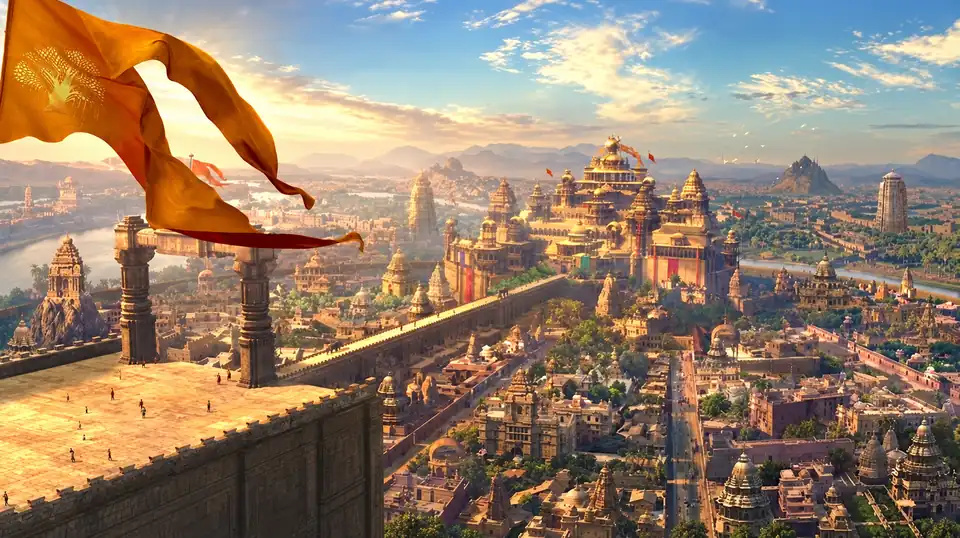
Why Do We Celebrate Dussehra?
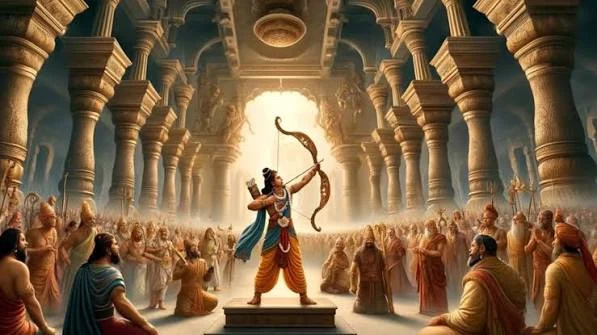
We celebrate Dussehra to honour Lord Rāmacandra's victory over Rāvaṇa, the king of Laṅkā, who had kidnapped Sītā. Śrīla Prabhupāda's books name the day directly, in this Bengali verse from the Caitanya-caritāmṛta:
vijayā-daśamī—laṅkā-vijayera dine
vānara-sainya kailā prabhu lañā bhakta-gaṇe
"On the victory day celebrating the conquest of Laṅkā-a day known as Vijayā-daśamī-Śrī Caitanya Mahāprabhu dressed up all His devotees like monkey soldiers." (Cc. Madhya 15.32)
Śrīla Prabhupāda himself marked the day in Vrindavan in 1977: "Vijayotsava. Today Rāmacandra conquered over Rāvaṇa" (room conversation, Vrindavan, 21 October 1977).
The deeper reason lies in why the Lord appears at all. Kṛṣṇa says He comes "to deliver the pious and to annihilate the miscreants, as well as to reestablish the principles of religion" (Bg. 4.8). In his purport, Śrīla Prabhupāda names Rāvaṇa as one of the demons the Lord vanquished in person, and explains that "the Lord especially descends to appease His unalloyed devotees, who are always harassed by the demonic."
So Dussehra is not only the defeat of a tyrant. It celebrates the Lord rescuing His devotee.
The Story of Dussehra: How Lord Rāma Defeated Rāvaṇa
Śrīmad-Bhāgavatam, Canto 9, Chapter 10, tells Lord Rāmacandra's pastimes in brief. Śukadeva Gosvāmī keeps the account short because King Parīkṣit had already heard it many times (SB 9.10.3).
Exile to the forest
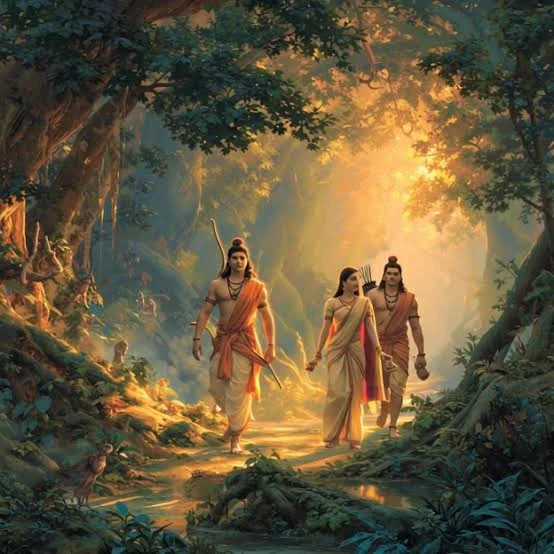
To keep His father's promise, Lord Rāma gave up His kingdom and went to live in the forest with Sītā (SB 9.10.8). His brother Lakṣmaṇa went with them.
The golden deer
Rāvaṇa sent the demon Mārīca, disguised as a golden deer, to draw Lord Rāma away from His hermitage. The Lord killed Mārīca with an arrow (SB 9.10.10).
Sītā is taken
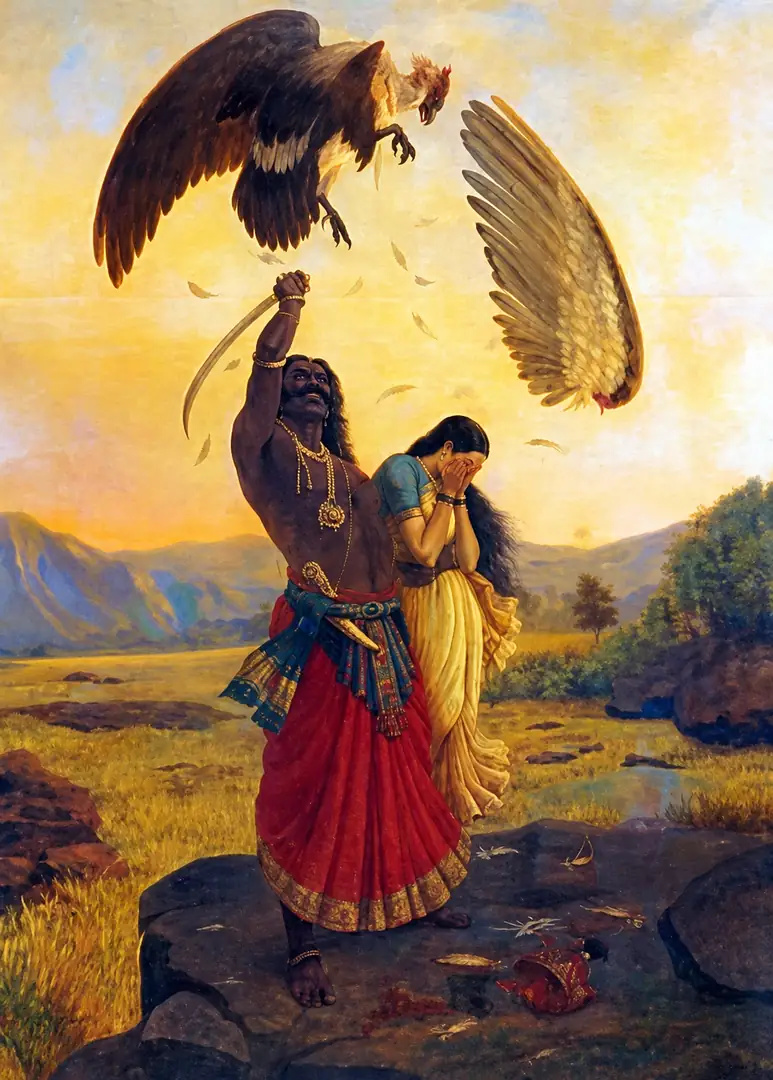
While Lord Rāma and Lakṣmaṇa were away, Rāvaṇa seized Sītā, and Lord Rāma wandered the forest lamenting His separation from her (SB 9.10.11).
This is not what it appears to be. In his purport, Śrīla Prabhupāda explains that Rāvaṇa could not actually take Sītā: what he took was māyā-sītā, an illusory form. Lord Rāma's lamentation, too, is a spiritual pastime of separation (vipralambha), because "the situation of Lord Rāmacandra is spiritual, for He does not belong to the material world" (SB 9.10.11, purport). The Bhāgavatam says the same elsewhere: being the Supreme, Lord Rāma could not truly suffer separation (SB 5.19.6).
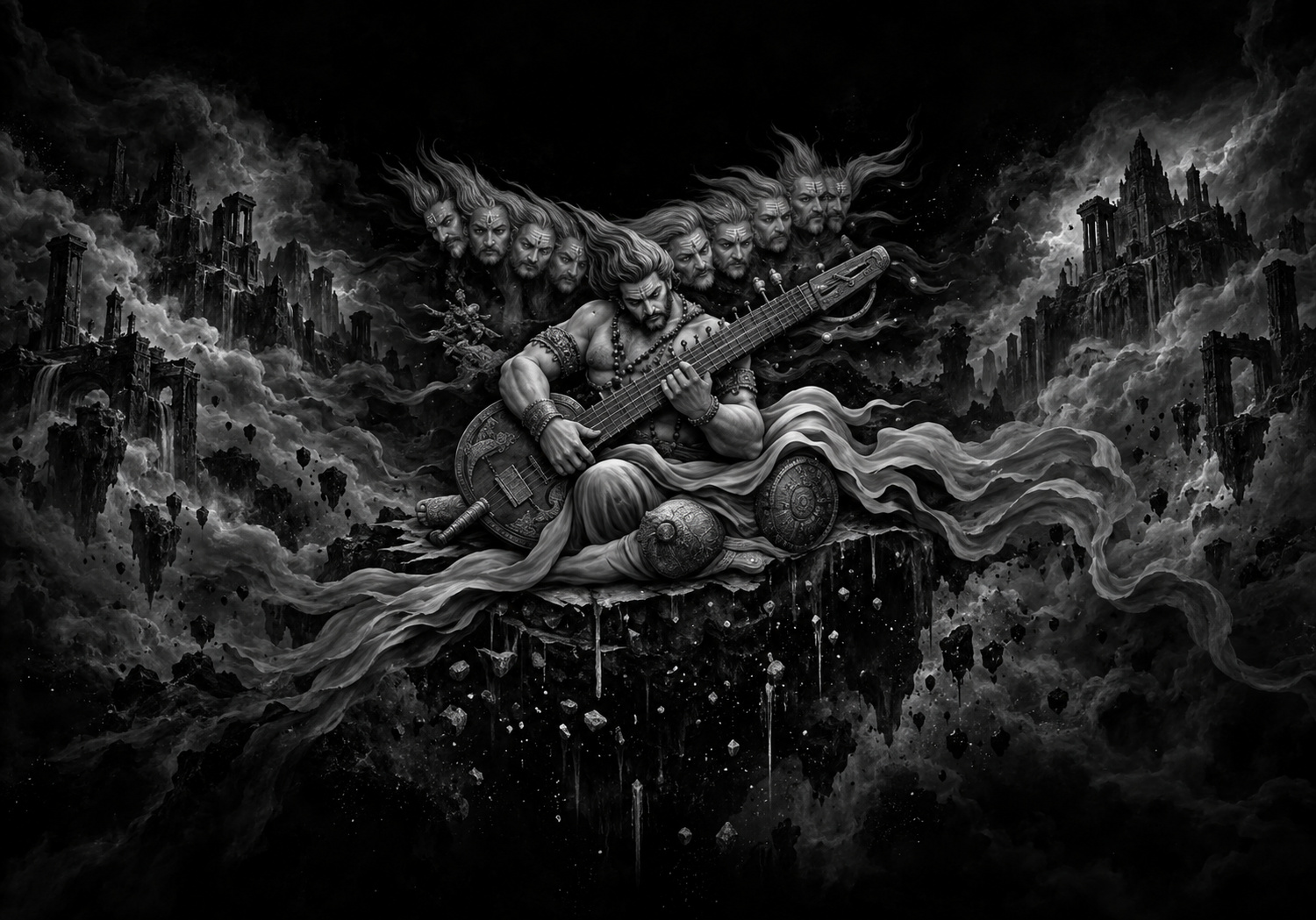
The Caitanya-caritāmṛta tells how Śrī Caitanya Mahāprabhu confirmed this on His tour of South India (Cc. Madhya 9.188–212):
- At Madurai, a brāhmaṇa named Rāmadāsa was fasting in grief because Mother Sītā had been touched by Rāvaṇa. Mahāprabhu told him that Sītā's form is spiritual and cannot be seen by material eyes, and that Rāvaṇa took only an illusory form.
- At Rāmeśvaram, Mahāprabhu heard the Kūrma Purāṇa recited. It describes how Sītā took shelter of Agni, the fire-god, who kept her safe and gave Rāvaṇa an illusory Sītā instead. After Rāvaṇa's death, when the illusory Sītā entered the fire, Agni returned the real Sītā to Lord Rāma.
- Mahāprabhu took the old manuscript leaves as evidence and brought them back to Rāmadāsa in Madurai.
This account comes from the Kūrma Purāṇa, as cited in Śrī Caitanya-caritāmṛta. It is not part of Vālmīki's Rāmāyaṇa.
The bridge to Laṅkā
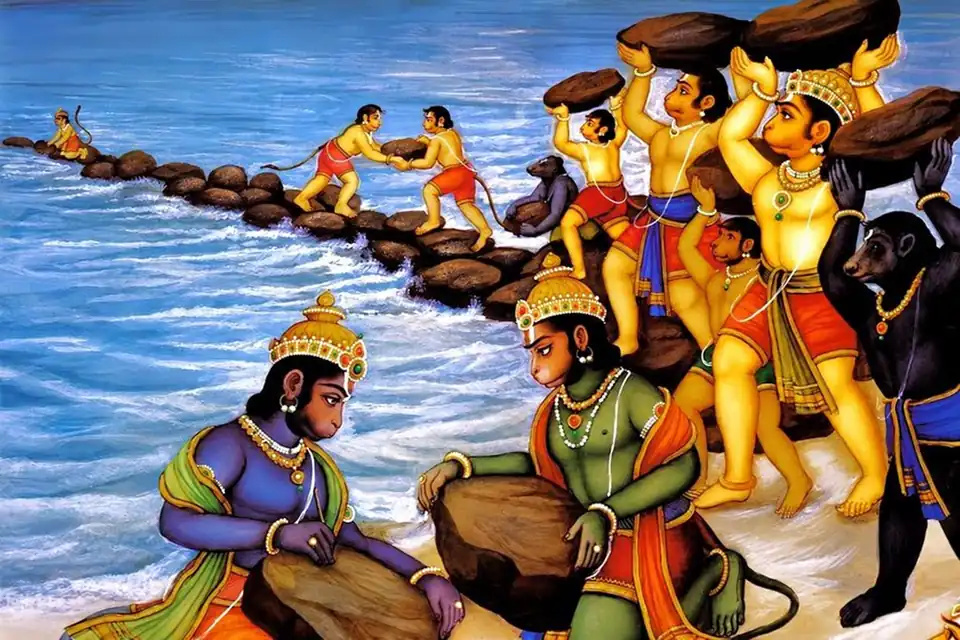
With Hanumān and the monkey army, the Lord reached the ocean. The monkeys threw mountain peaks into the sea to build a bridge, and Lord Rāma marched on Laṅkā, guided by Rāvaṇa's brother Vibhīṣaṇa (SB 9.10.16).
Rāvaṇa falls

After a great battle, Lord Rāma faced Rāvaṇa himself:
evaṁ kṣipan dhanuṣi sandhitam utsasarja
bāṇaṁ sa vajram iva tad-dhṛdayaṁ bibheda
so 'sṛg vaman daśa-mukhair nyapatad vimānād
dhāheti jalpati jane sukṛtīva riktaḥ
"After thus rebuking Rāvaṇa, Lord Rāmacandra fixed an arrow to His bow, aimed at Rāvaṇa, and released the arrow, which pierced Rāvaṇa's heart like a thunderbolt. Upon seeing this, Rāvaṇa's followers raised a tumultuous sound, crying, "Alas! Alas! What has happened? What has happened?" as Rāvaṇa, vomiting blood from his ten mouths, fell from his airplane, just as a pious man falls to earth from the heavenly planets when the results of his pious activities are exhausted." (SB 9.10.23)
Sītā is found

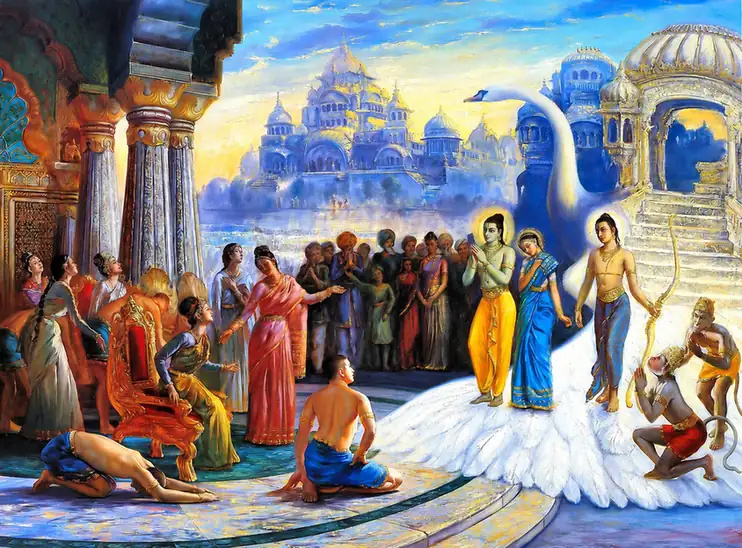
Lord Rāma found Sītā in the Aśoka grove, sitting in a small cottage beneath a Śiṁśapā tree, thin and grieving from separation from Him (SB 9.10.30). Vibhīṣaṇa was given the rule of Laṅkā (SB 9.10.32), and the Lord returned to Ayodhyā, where He was crowned king (SB 9.10.48–50).
Read the full story
The Bhāgavatam tells Lord Rāma's pastimes in brief. To read the whole story told at length, turn to Krishna Dharma Dasa's retelling of the Rāmāyaṇa, which follows Vālmīki's account. It is especially good for reading aloud with the family over the festival days.
What Does the Word Dussehra Mean?
Dussehra is most commonly derived from the Sanskrit daśa-harā: daśa, "ten", and harā, "removal" or "defeat". It is usually read as the defeat of the ten-headed Rāvaṇa. This derivation comes from popular usage; it was not taught by Śrīla Prabhupāda.
What the Bhāgavatam does confirm is Rāvaṇa's ten heads. When Lord Rāma's arrow struck him, he fell "vomiting blood from his ten mouths" (daśa-mukhaiḥ, SB 9.10.23).
Vijayadashami, the festival's other name, is explained in Śrīla Prabhupāda's own word-for-word translation: vijayā means "victory" and daśamī means "tenth day" (Cc. Madhya 15.32). It is the victory day, kept on the tenth day of the bright fortnight of Ashvin.
Dussehra is also known as
- Vijayadashami, across most of India
- Dasara, in Karnataka and much of the South
- Bijoya Dashami, in Bengal
- Dashain, in Nepal
- Rāmacandra Vijayotsava, Lord Rāma's victory festival, in the Vaishnava calendar
Dussehra and Vijayadashami: Are They the Same Festival?
Yes. Dussehra and Vijayadashami are two names for the same day, the Shukla Dashami of Ashvin. "Dussehra" is the name most used in North India; "Vijayadashami" is the Sanskrit name used across the country.
The difference is one of emphasis by region:
| Dussehra (North India) | Vijayadashami (Bengal and the East) | |
|---|---|---|
| Main focus | Lord Rāma's victory over Rāvaṇa | The close of Durga Puja |
| Typical observance | Rāmlīlā and Ravan Dahan | Immersion of the Durga image |
These regional customs come from local tradition. In Śrīla Prabhupāda's books, Vijayā-daśamī is the day celebrating the conquest of Laṅkā. On that day Śrī Caitanya Mahāprabhu took the mood of Hanumān, climbed the walls of a mock Laṅkā fort and began to dismantle it (Cc. Madhya 15.33), crying, "Where is the rascal Rāvaṇa? He has kidnapped the universal mother, Sītā" (Cc. Madhya 15.34).
Why Is Dussehra Celebrated After Navratri?
Dussehra follows Navratri in the lunar calendar. Navratri covers the first nine nights of the bright fortnight of Ashvin, and Dussehra is the tenth day, the Dashami.
How people connect the two comes from regional tradition:
- In Bengal and the East, the nine nights are kept as Durga Puja, and the tenth day closes the festival.
- In North India, Rāmlīlā plays are often staged across the nine nights, so that Rāvaṇa's defeat is enacted on the tenth.
Śrīla Prabhupāda did not link the two festivals, but he did explain who Durgā is. She is the Lord's material energy, and although she is extremely powerful, "she acts under the direction of the Supreme Personality of Godhead, Kṛṣṇa, not independently" (SB 6.17.29, purport). Elsewhere he writes simply, "Prakṛti is Durgā" (SB 8.12.40, purport).
That is why worship of the Supreme Lord satisfies everyone. The Bhāgavatam compares it to watering a tree: "As pouring water on the root of a tree energizes the trunk, branches, twigs and everything else," so serving the Lord satisfies all (SB 4.31.14). For devotees, the tenth day is Lord Rāma's victory.
What Does Dussehra Symbolise? Lessons Beyond "Good over Evil"
Dussehra is usually summed up as the victory of good over evil. The Bhāgavatam's account of Lord Rāma gives that phrase more depth.
1. Duty can ask for sacrifice
Lord Rāma gave up His kingdom so that His father's word would be kept (SB 9.10.8). He chose duty over comfort.
2. Power does not protect wrongdoing
Rāvaṇa had a great kingdom and every material opulence. Śrīla Prabhupāda writes that "because of his sinful act of kidnapping mother Sītā, all the results of his pious activities were destroyed," and warns: "One should not be proud of one's exalted position and act like Rāvaṇa, thinking oneself independent of material nature's laws" (SB 9.10.23, purport).
3. Lust, anger and greed must be given up
After Rāvaṇa's fall, his queens lamented that his lust had blinded him to Sītā's power (SB 9.10.27). Lust brought down the most powerful king of his age.
People often speak of burning the "Rāvaṇa within". That is a helpful image, though no verse equates Rāvaṇa's heads with our faults. Kṛṣṇa does name the enemies plainly:
tri-vidhaṁ narakasyedaṁ
dvāraṁ nāśanam ātmanaḥ
kāmaḥ krodhas tathā lobhas
tasmād etat trayaṁ tyajet
"There are three gates leading to this hell—lust, anger, and greed. Every sane man should give these up, for they lead to the degradation of the soul." (Bg. 16.21)
4. Devotion matters more than status
Lord Rāma accepted the forest-dwelling monkeys as His friends, though they had no noble birth, beauty or learning. The Bhāgavatam says that "none of these qualifications is actually a prerequisite for friendship with Lord Śrī Rāmacandra" (SB 5.19.7). Sincere devotion is what qualifies a person.
5. The Lord teaches by His own example
The Bhāgavatam explains that Lord Rāma's purpose was not only to kill Rāvaṇa but also to teach human beings (SB 5.19.5). In his purport, Śrīla Prabhupāda explains that by personally rescuing Sītā, Lord Rāma showed a husband's duty to protect his wife, even at great hardship.
6. The Lord comes for His devotees
Dussehra shows why the Lord appears. Śrīla Prabhupāda writes that "the Lord especially descends to appease His unalloyed devotees" (Bg. 4.8, purport). The battle of Laṅkā was fought for Sītā.
7. Even Rāvaṇa received the Lord's mercy
The Bhāgavatam reveals who Rāvaṇa really was. He and his brother Kumbhakarṇa were Jaya and Vijaya, doorkeepers of Vaikuṇṭha, who had been cursed by the Kumāras to take birth as demons (SB 7.1.38–39). Lord Rāmacandra appeared to kill them, releasing them from the curse (SB 7.1.44–45), and they returned to the Lord's shelter, back to Godhead (SB 7.1.47).
So Dussehra is more than a contest between good and evil. Even the Lord's killing of Rāvaṇa is His mercy.
The History of Dussehra: From the Rāmāyaṇa to Rāmlīlā and Ravan Dahan
Dussehra begins with Lord Rāma's pastimes, first told in Vālmīki's Rāmāyaṇa. The Śrīmad-Bhāgavatam gives a condensed account in Canto 9, Chapter 10. In his purport to SB 9.10.3, Śrīla Prabhupāda notes that many versions of the Rāmāyaṇa exist, and that only accounts given by tattva-darśīs, realised souls, are authoritative.
The earliest celebration of the day recorded in Śrīla Prabhupāda's books is Śrī Caitanya Mahāprabhu's, at Jagannātha Purī. He dressed His devotees as monkey soldiers, took the mood of Hanumān and stormed a mock Laṅkā fort. "Everyone became very astonished to see the emotional ecstasy of Śrī Caitanya Mahāprabhu, and everyone began to chant, 'All glories! All glories!' again and again" (Cc. Madhya 15.35). Remembering the Lord's victory through drama has a devotional precedent.
Two public customs are especially associated with Dussehra today:
- Rāmlīlā is a folk drama of the Rāmāyaṇa, staged over the nights before Dussehra, especially in Ayodhyā, Varanasi and Vrindavan. Most Rāmlīlā performances follow Tulasīdāsa's Rāmacaritamānasa rather than Vālmīki's text. UNESCO lists the Rāmlīlā tradition as an element of intangible cultural heritage.
- Ravan Dahan, the burning of giant effigies of Rāvaṇa, Kumbhakarṇa and Meghanāda, closes the festival in many North Indian towns. It is a later custom, not one taught by Śrīla Prabhupāda, and it is distinct from Hanumān setting fire to Laṅkā in the Rāmāyaṇa itself.
Both customs carry on the spirit of Mahāprabhu's Vijayadashami: celebrating the Lord's victory together. At Vrindavan Chandrodaya Mandir, we hold Rāmlīlā and Ravan Dahan on Tuesday, 20 October from 6:00 pm (see below).
How Do Dussehra Celebrations Differ Across India?
The customs below are regional traditions, not taught by Śrīla Prabhupāda.
| Region | How the day is kept |
|---|---|
| North India (Delhi, UP, Vrindavan) | Rāmlīlā plays over the nine nights, ending with Ravan Dahan on Dussehra evening |
| Kullu, Himachal Pradesh | Kullu Dussehra begins on Vijayadashami and runs for a week, with village deities carried in procession |
| Mysuru, Karnataka | Mysuru Dasara ends with the Jamboo Savari elephant procession |
| Bengal, Assam, Odisha | Bijoya Dashami closes Durga Puja with immersion of the image |
| Karnataka, Kerala, Tamil Nadu | Ayudha Puja on the ninth day honours tools and books; on Vijayadashami many children begin their first lessons (Vidyarambham) |
| Maharashtra | Āpṭā leaves are exchanged as "gold"; Śamī and Aparājitā pūjā are also kept |
| Nepal | Dashain, the country's largest festival |
Among Vaishnavas, the day is kept as Lord Rāma's victory festival, with kīrtana, hearing His pastimes and offering to the Deity.
Why Is Vijayadashami Auspicious for New Beginnings?
In the jyotiṣa tradition of western India, Vijayadashami is one of the sāḍe-tīn muhūrta, the "three and a half" days held to be auspicious in themselves. The other full days are Gudi Padwa (Chaitra Shukla Pratipada) and Akṣaya Tṛtīyā, and Bali Pratipadā after Dīpāvalī is counted as the half. On these days people begin new ventures, buy gold, property or vehicles, or start a child's education without consulting a separate muhūrta. This belief was not taught by Śrīla Prabhupāda, and no verse promises success to work begun on this day.
The Bhagavad-gītā offers a different way to begin anything well. Kṛṣṇa tells Arjuna:
yat karoṣi yad aśnāsi
yaj juhoṣi dadāsi yat
yat tapasyasi kaunteya
tat kuruṣva mad-arpaṇam
"O son of Kuntī, all that you do, all that you eat, all that you offer and give away, as well as all austerities that you may perform, should be done as an offering unto Me." (Bg. 9.27)
If you are starting something new on Dussehra, begin it as an offering to the Lord: chant His name, offer your work to Him, and take His prasādam.
Celebrate Dussehra with Vrindavan Chandrodaya Mandir
At Vrindavan Chandrodaya Mandir, we celebrate Dussehra on Tuesday, 20 October 2026, with Rāmlīlā followed by Ravan Dahan from 6:00 pm. You are welcome to join us.
The Śrīmad-Bhāgavatam describes Hanumān hearing Lord Rāma's glories with complete attention, and says, "That chanting is always extremely auspicious" (SB 5.19.2). Remembering the Lord's pastimes does not end with the story; it carries into service.
Here in the sacred land of Vrindavan, where Sri Sri Radha Vrindavan Chandra reside, you can join us in serving the Lord this Dussehra:
- Mandir Nitya Seva: sponsor the daily worship of Sri Sri Radha Vrindavan Chandra, such as a garland, a dress, a meal offering or an ārati. Offer Nitya Seva
- Annadan: share prasādam with the sadhus and pilgrims who come to our temple. Offer Annadan
- Gau Seva: serve the cows of Braj, so dear to Lord Kṛṣṇa, at our Surabhi Gaushala. Offer Gau Seva
- Mandir Nirman: support the construction of Vrindavan Chandrodaya Mandir, a temple dedicated to spreading the glories of Lord Kṛṣṇa. Offer Mandir Nirman seva
For the Dashami tithi timings and a home puja vidhi, see Dussehra 2026: Date, Tithi, Puja Vidhi and Significance.
Frequently Asked Questions About Dussehra's Story and Significance
1. Why do we celebrate Dussehra?
To honour Lord Rāmacandra's victory over Rāvaṇa and the rescue of Sītā. Śrīla Prabhupāda's books call Vijayā-daśamī the day celebrating the conquest of Laṅkā (Cc. Madhya 15.32).
2. What is the story of Dussehra in brief?
Lord Rāma went into exile to keep His father's promise. Rāvaṇa took Sītā (in truth, only an illusory Sītā), and Lord Rāma, with Hanumān and the monkey army, built a bridge to Laṅkā and killed Rāvaṇa with an arrow to the heart (SB 9.10.23).
3. Did Rāvaṇa really take Sītā?
No. Śrīla Prabhupāda explains that Rāvaṇa took only māyā-sītā, an illusory form (SB 9.10.11, purport). The Kūrma Purāṇa, as cited in the Caitanya-caritāmṛta, describes how Agni protected the real Sītā and returned her to Lord Rāma (Cc. Madhya 9.199–212).
4. Who helped Lord Rāma enter Laṅkā?
The monkey army built the bridge across the ocean, and Rāvaṇa's brother Vibhīṣaṇa guided Lord Rāma into Laṅkā (SB 9.10.16).
5. What is the meaning of Dussehra?
It is commonly derived from daśa-harā, "the defeat of the ten-headed one", meaning Rāvaṇa. This derivation comes from popular usage and was not taught by Śrīla Prabhupāda.
6. What does Vijayadashami mean?
Vijayā means victory and daśamī means tenth day (Cc. Madhya 15.32).
7. What is the difference between Dussehra and Vijayadashami?
They are the same day. "Dussehra" is the common North Indian name, centred on Lord Rāma's victory. "Vijayadashami" is the Sanskrit name; in Bengal it also marks the end of Durga Puja.
8. Dussehra is also known as?
Vijayadashami, Dasara, Bijoya Dashami, Dashain and, in the Vaishnava calendar, Rāmacandra Vijayotsava.
9. What does Dussehra symbolise?
The Lord's protection of His devotees and His restoration of dharma (Bg. 4.8). It also reminds us that power cannot protect wrongdoing, that lust, anger and greed must be given up (Bg. 16.21), and that even the Lord's killing of Rāvaṇa was His mercy (SB 7.1.44–47).
10. What does Lord Rāma's friendship with the monkeys teach?
That the Lord values devotion, not birth, beauty or learning (SB 5.19.7).
11. Is burning Rāvaṇa's effigy prescribed in scripture?
It is a later custom, not a scriptural injunction. It carries on the spirit of Śrī Caitanya Mahāprabhu's Vijayadashami, when He and His devotees enacted the conquest of Laṅkā (Cc. Madhya 15.32–35). At Vrindavan Chandrodaya Mandir, Rāmlīlā and Ravan Dahan are held on 20 October from 6:00 pm.
12. Does the Bhagavad-gītā promise success for work begun on Dussehra?
No. Bg. 9.27 teaches that everything we do should be offered to Kṛṣṇa. The belief that Vijayadashami is auspicious for new ventures comes from the jyotiṣa tradition of the sāḍe-tīn muhūrta, and was not taught by Śrīla Prabhupāda.
Hare Kṛṣṇa!